March 8 is International Women’s Day. This day of celebration began in 1910 to demonstrate unhealthy working conditions for women and the IWD demonstrations in 1917 were some of the first of the Russian revolution. The day has traditionally been a time to show respect for women employees, but has now become a day like Valentine’s Day or Mother’s Day to buy flowers or little gifts for the women in ones life. The main square of Nova Gorica is planted with vendors selling flowers and plants and men are seen carrying bouquets all over town. I think the US should honor this day as well. Women really do need to be reminded that all the little things they do [scrubbing bathrooms, changing beds, sweeping, cooking special meals, hugging crying children] are greatly appreciated. I wonder if there is also an International Man’s Day?
The gymnasia graduating students celebrate the end of their public schooling with the matura dance [the matura is their exit exam]. Fourth year students and their families attend a dinner in the sports complex decorated with balloons, draped fabric, long tables with table cloths, candles, flowers and runners to match the napkins. Food is served in courses from buffet tables around the room through out the night. A live band plays music for dancing beginning at 8:00pm until 4:00am and people really know how to dance. Couples glide across the floor in a style with an ease that only comes with hours of dancing together. Many of the students are almost unrecognizable dressed in floor length gowns and hours of preparation to get their hair to pile so high on their heads, but just as many are looking more comfortable in regular street clothes. The ceremony begins with a grand musical entrance to a Strauss waltz and then the entire class exhibits a fabulous demonstration of dance styles from contra dances though the tango. All the students take dance classes at private ballroom dance studios and practice all year for this moment. It is amazing to watch the students execute the dance steps with precision and joy. Each homeroom also gives a presentation [many power point photos of excursions, projects and kids being silly] and special moments of gratitude to their homeroom teacher [one teacher received a wheelbarrow full of flowers – one plant from each student]. We left at 1:00 and dessert had not been served yet and people were still going strong. The students dance until dawn when the last ones leave at 6:00am. It is especially nice to see the families in attendance. Not only parents are in attendance, but in some cases grandparents and younger siblings are gathered around the table seated with the guest of honor, their graduating student. The students have a national dance day planned on the last day of classes in May. All over Slovenia 4th year students will gather and dance their routines in an attempt to win a Guinness world record and another way to put Slovenia on that map.
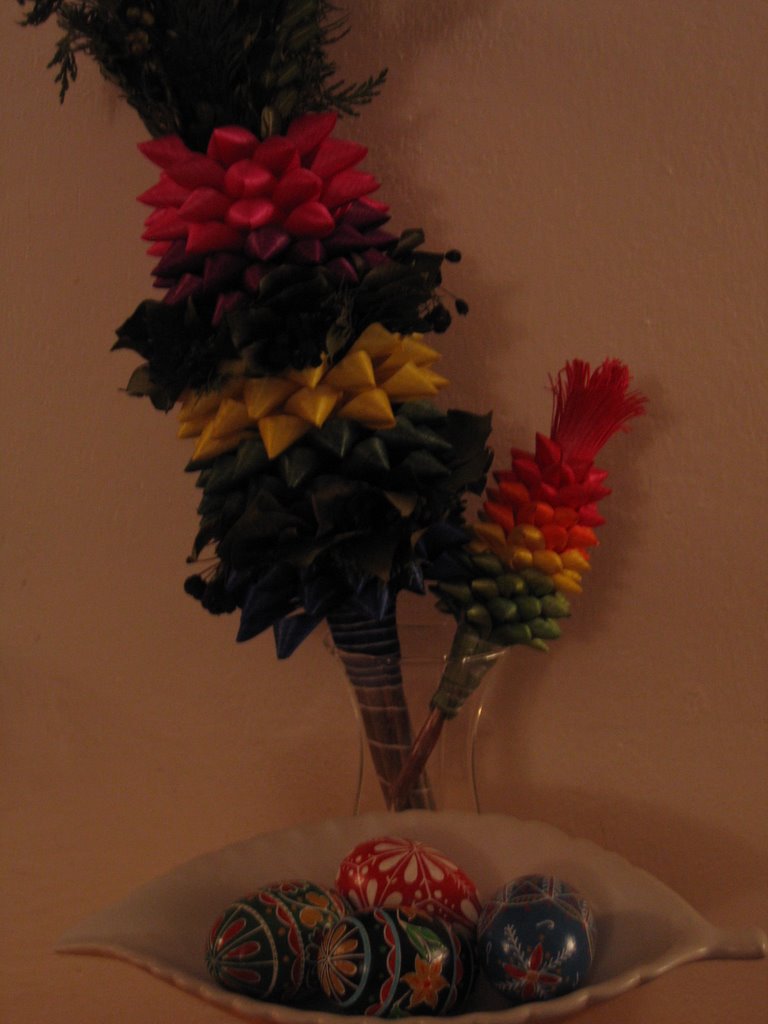
Easter celebrations are many and varied. The priest blesses the trimmings from the olive trees on Palm Sunday and they are then carried home to represent the palm branches used to celebrate the entrance of Jesus into Jerusalem. In Ljubljana where they have no olive trees, butar are made from dyed wood shavings and greenery from bushes that all bundled together to make a wand that is blessed at church. People make dyed eggs by hard-boiling them with the skins of onions. Some place flower petals and leaves on the eggs, wrap them in cheesecloth put them with the onionskins in the boiling water and then when the leaves are removed the designs are white on the burgundy colored eggs. Eggs painted in tradition designs are available to buy in wood, but like many of their traditional art forms I am assuming this one is disappearing too. Food is brought to the church on Easter eve to be blessed, bread [the body of Christ], wine [the blood of Christ], horse radish [the nails of the crucifixion] and eggs [shell is the tomb and the yolk is new life]. These are the first foods one is supposed to eat on Easter Sunday. Easter Saturday at Sveta Gora is the major service and is over 2 hours in length including a great deal of incense, a procession around the outside of the church [with Kay sight reading Slovenian hymns while walking around the church on the wet stones in the dark – it probably is not my best singing ever]. I have never seen anyone so excited about the resurrection as Brother Ambrose. He dances from one person to another wishing Velika No^c hugging and kissing, giggling that the resurrection has happened. After this long evening of course the choir gets together for food, wine, traditional Easter foods and lots and lots of laughter.
Our son Aaron visited with us for 5 weeks and his partner Elle for 2. This was Elle’s first visit to Europe so we were able to give her the experience of 3 countries. We all went to Cres, a Croatian island in the Adriatic. The city of Mali Locinj is a popular retreat spot for Slovenians and we headed there for a couple of days. Unfortunately the weather was rainy the entire time so we were only able to do a little bit of hiking, but there are paths all over the island, around the shore and following rock walls. The people who have lived on this island have had to remove an enormous number of rocks to find land to cultivate or to use as pasture for animals. Small plots still protect sheep in some areas, but mostly the land is left to scrub growth and the economy has adapted to the tourists who come to breathe the fresh air scented with pine and salt while walking and sitting in cafes.
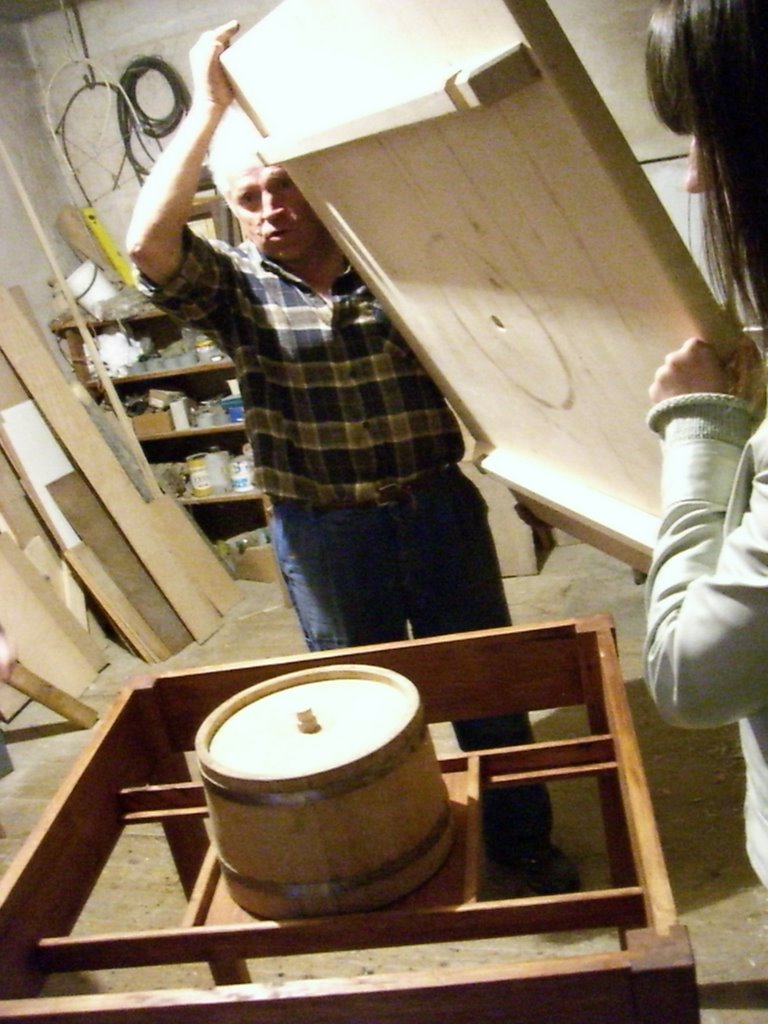
We visited Bob’s family in Podlipa and went to the home of Vinko to try the spinning table. He built this wooden table following a 300-year-old tradition that has been passed through the family. The table is a little bigger than a card table standing high on 4 strong legs with a barrel secured under the top. The unfinished tabletop fits into a wooden knob on the top of the barrel and is able to move around in a circle on this knob although not easily because it was wood against wood. Eleven of us gathered around his table, we were told that the table would move clockwise if our palms were flat on the table and counter-clockwise if the backs of our hands were on the table. It took about 20 minutes of standing talking together with our hands on the table before it started to move. It slowly edged clockwise and then picked up speed as we all moved around it with our palms flat on the table, then Vinko told us to change and the table came to a complete stop and with the backs of our hands on the table it started to move the other direction. We went back and forth for a while and then people started to step away from the table leaving just 4 of us [my son Aaron, Elle, a cousin and me] and the table moved faster and faster and faster until we were running to stay with it. None of us was pushing it I am certain, it moved because we all believed that it could and the power of our thought made it happen. The room had a number of doubters and a numbers of would be believers, but when we were finished I thin everyone believed that the human brain and collective thought is a powerful thing.
It is interesting for us to try to imagine how Aaron and Elle are seeing things for the first time; these same sights that we now take for granted. How odd that the water rolling out of the mountain in Vipava, the snow capped peaks of the Julian alps, the turquoise So^ca river, the alpine towns, the coastal medieval villages, the border crossings, Friday night wine at the Italian wine bar and festivals in ancient castles can seem common place to us now that we’ve been here 7 months.
Saturday, May 20, 2006


Friday, May 19, 2006


In April the teachers from Solski Center plan an annual bus trip together for 4 days. Last year they went to Berlin, this year we all head to the region of Puglia in the south of Italy. Passing along the calm Adriatic on the route to the spur of the Italian boot are rows and rows of fruit trees drastically pruned like butchered limbs dotted with pale pink soft delicate lace on the deformed branches, and miles and miles and miles of grape arbors and olive groves. This area was thought to be once a part of the Croatian coast and the rock formations, soil and hills that should have been the foothills of the Dalmatian mountains now rest in Italy thanks to plate tectonics. For miles the area appears to be isolated, lost and forgotten protected only by old men chatting on benches dressed in the uniform of shirts, sweaters, jackets, hats and ties. Then out of nowhere a modern city with new apartments and buildings teeters on the rocks. The Commune di San Giovanni Rotondo is expanding due to thousands of pilgrimages who come to the hospital and church dedicated to Padre Pio. Padre Pio bore the stigmata of Christ for 50 years until right before he died in 1968 and was declared venerable by the pope in 1998. The faithful come from all over the world to this harsh land seeking a connection with God though this holy man who suffered the pains of the Savior, and many, many hotels and restaurants have risen to care for the pilgrims while they are here. Pilgrimages are very present in the Catholic faith here. Holy days are celebrated, the saints are remembered and given credit for natural happenings. I too feel the presence of something spiritual when I visit these sights, but more than the presence of a relic I think I feel the deep heart felt searching of those who come seeking.
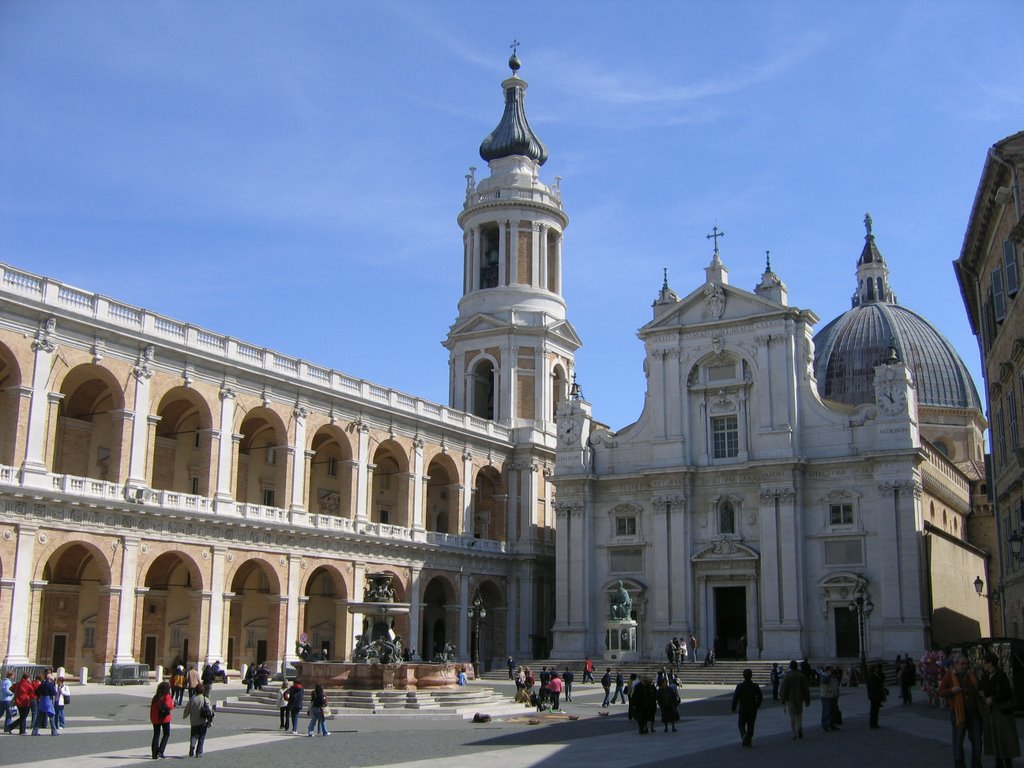
In Monte Sant’Angelo we visit the hill top city where crusaders trained and received spiritual preparation before sailing from Bari to the holy land. The grotto under the church is believed to be the earthly home of the Archangel Michael and this was the second largest pilgrimage site after Rome during the middle ages. There were strong beliefs that the world would end in 1,000 so believers stopped creating and constructing in their home towns and traveled to holy sites to see the sacred relics before the end times. These pilgrimage roads leading from the British Isles to Italy intersected in France and the first tourist economy sprang up along these journey paths leading to the beautiful monasteries that housed the plunder brought back by the crusaders beginning in 195. One relic we experience on this trip is the house of Mary the mother of Jesus thought to have been brought to Italy by the angels. Actually it is a house made of stone, proven to be from the holy land from the time of Christ, that was brought by the D’Angelo family to preserve it from possession by the Muslims. It now sits within a basilica and is a place of unique smells and the feeling of warmth within the stonewalls.
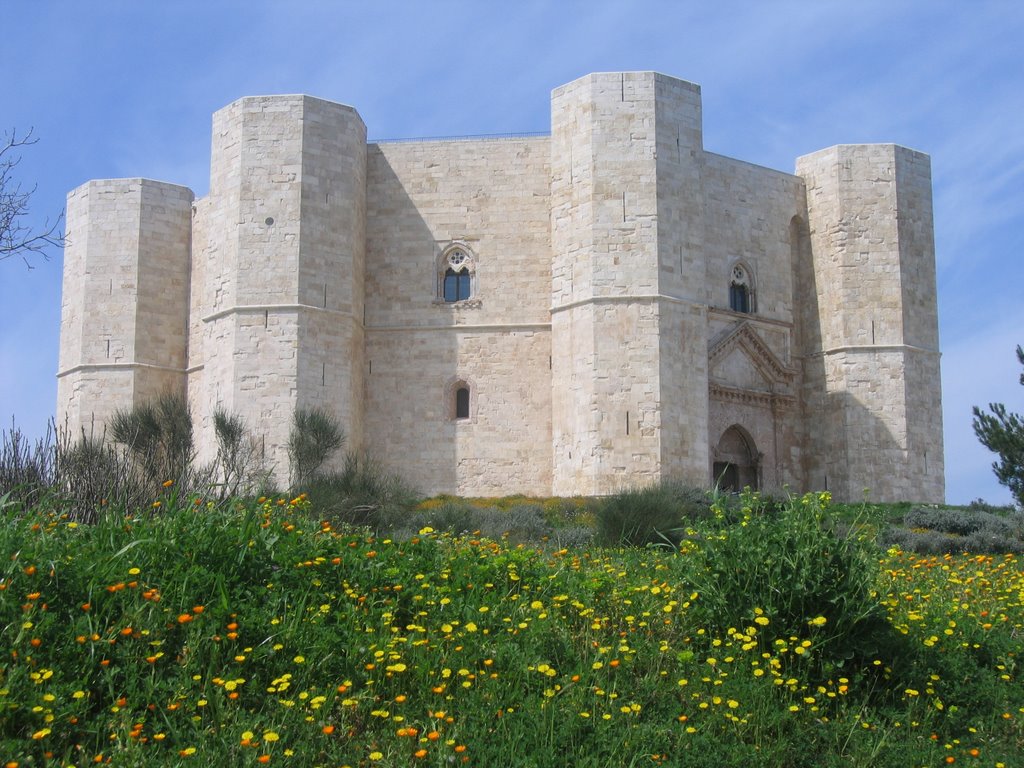
Around 1,150, when it appeared that the world was not going to come to a fiery end, the faithful began to build churches in their hometowns with a focus on judgment and repentance. Those who had traveled to far exotic places brought back unusual ideas, stories of happenings and images of unusual creatures that can be seen in the designs of the churches and castles in Southern Italy. One such exotic building is the Castel del Monte, built by Frederic II between 1229 & 1249. It is a gigantic octagonal shaped hunting lodge that looms on the hill above the surrounding olive groves. The building is decorated with Eastern designs in doorways and windows carved from red aggregate, marble columns streaked with orange and trimmed with floral extensions, spiral stair cases and an upstairs indoor toilet.
In Bari, in the Basilica di San Nicola, the remains of St. Nicholas [of Christmas fame] are found. Stolen from Myra by Italian sailors in 1087 the remains have held a great fascination due to the continuous extraction of liquid manna from the bones. The presence of holy relics and people who come to worship in these places is fascinating to me. So many of the buildings are built on the Roman ruins of temples and the energy for centuries is one of seeking and believing. I find it difficult to understand the power of holy objects, but I bask in the seeking of things spiritual.
Outside of Bari we visit a producer of olive oil. Il Fratolo D’Amico processes totally biological olive oil with in 12 hours after picking the fruit from the trees. Many of the trees are ancient goddesses 3 – 400 years old standing watch within walled fields of flowers. The slow process grinds the olives by large stones. The lacrima, or the tears, pools on the pulp and is ladled in the first 10 minutes for the purest olive oil. Then the pulp is pressed on mesh discs for 4 hours and the oil that is extracted is extra virgin. The faster process grinds the olives with metal discs using centrifugal resulting in an oil of a much lower quality. I have never before tasted oil that tastes like the smell of freshly cut grass. I am definitely spoiled for life.
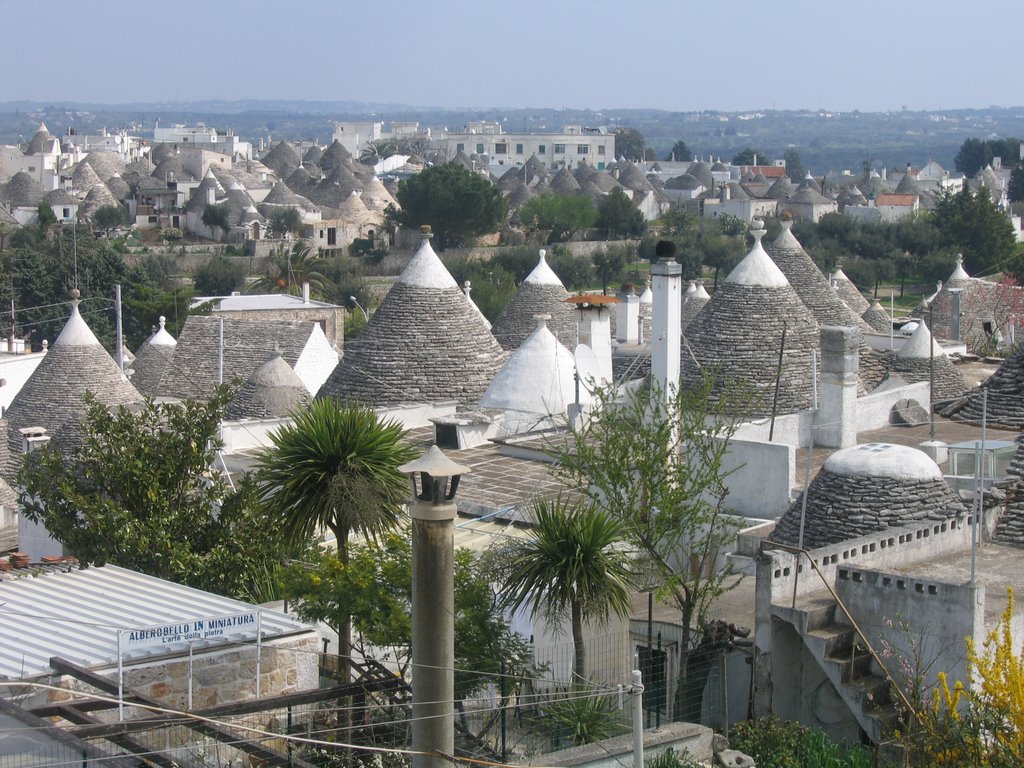
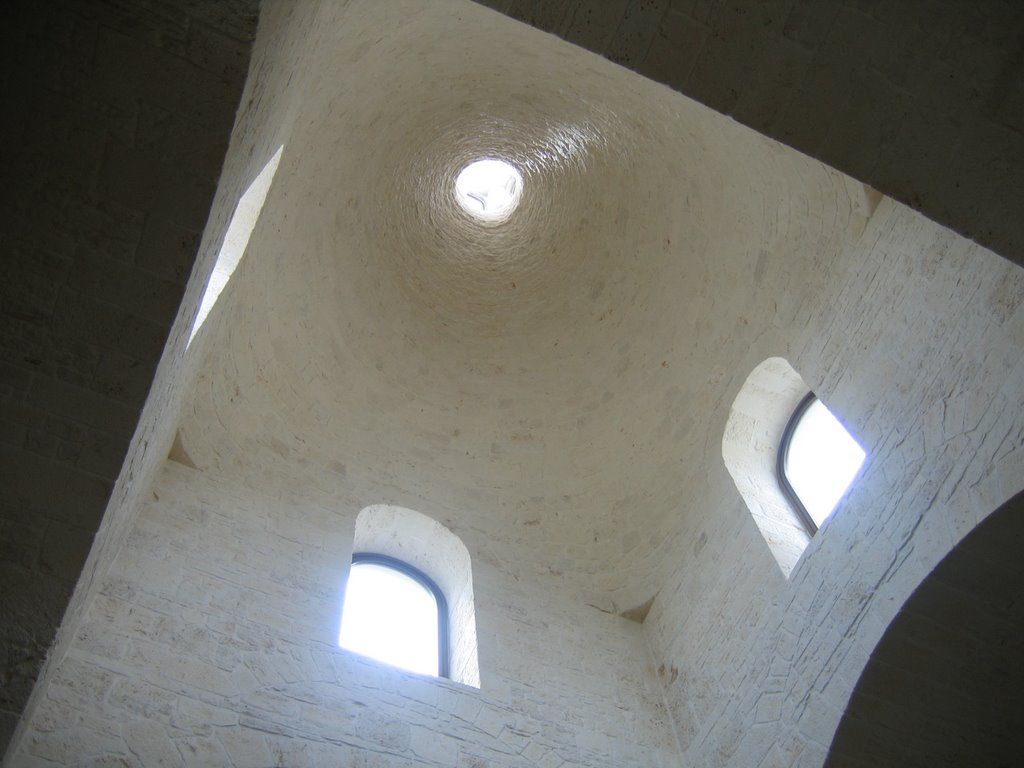
The place I found the most fascinating was Alberobello. This UNESCO [unesco.org] site is a community of trulli buildings, cone shaped houses, built in the ancient style of motarless construction. Legend says that the residents were able to dismantle their homes when the taxman came to avoid paying taxes on structures built on the king’s land. After he had passed, what appeared to be piles of rubble, the houses were reconstructed until the next visit. The streets weave around hobbit houses painted stark white with flat stone conical roofs capped with pieces bearing ancient symbols. The double walls are layers of flat rock over loose stone used for insulation. The interior is an even temperature all year, the walls are stuccoed and white washed with curtains separating the sparse rooms that were originally heated by the cooking fire. The children sleep in loft spaces closest to the rising warmth and water is stored in a cistern below the structure. Many of the buildings we saw are tourist shops, but the community consists of over a hundred homes that are lived in and lovingly maintained. This was once a thriving neighborhood of those who could afford no less, but now it is a prestigious place for a weekend home.
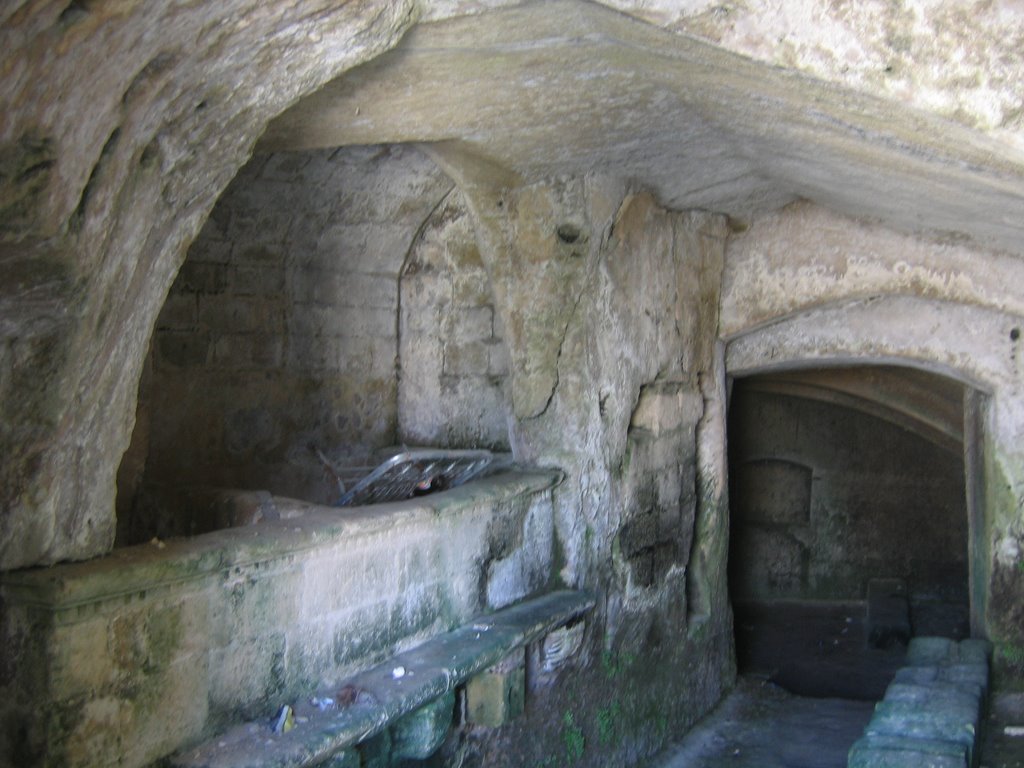
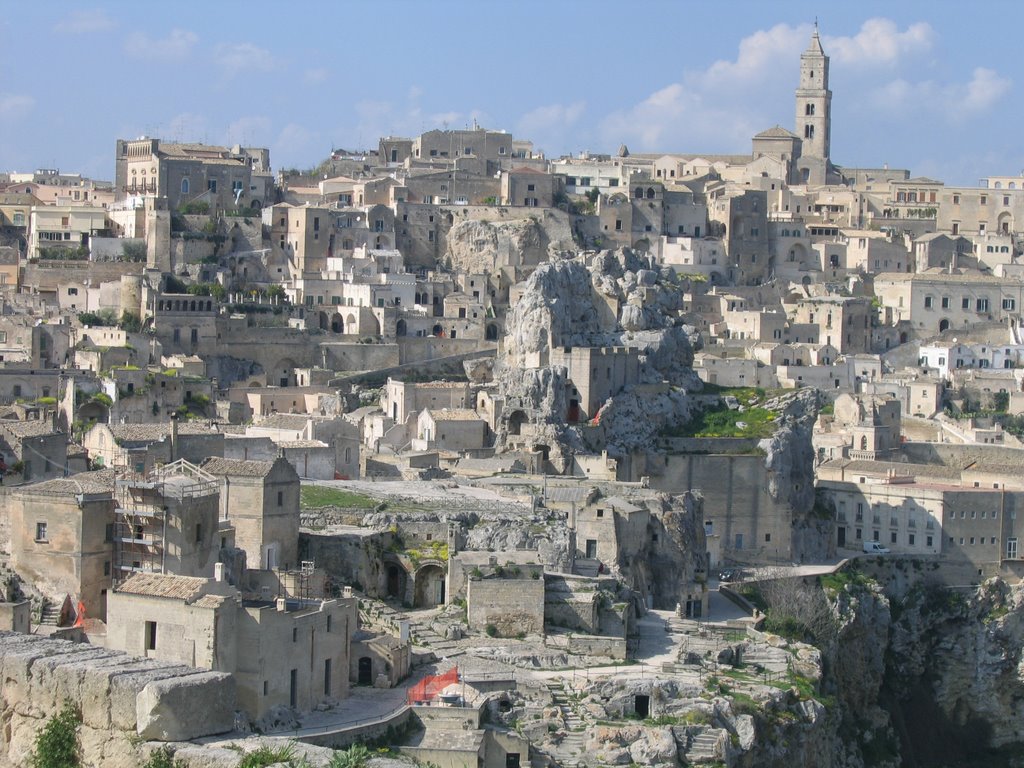
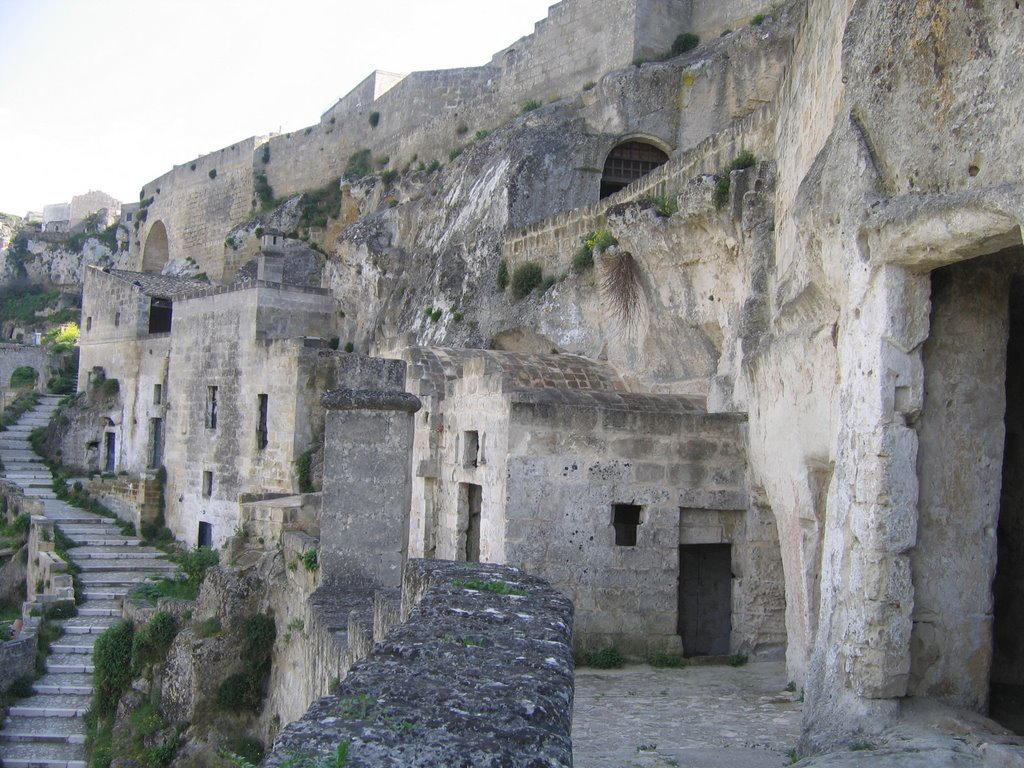
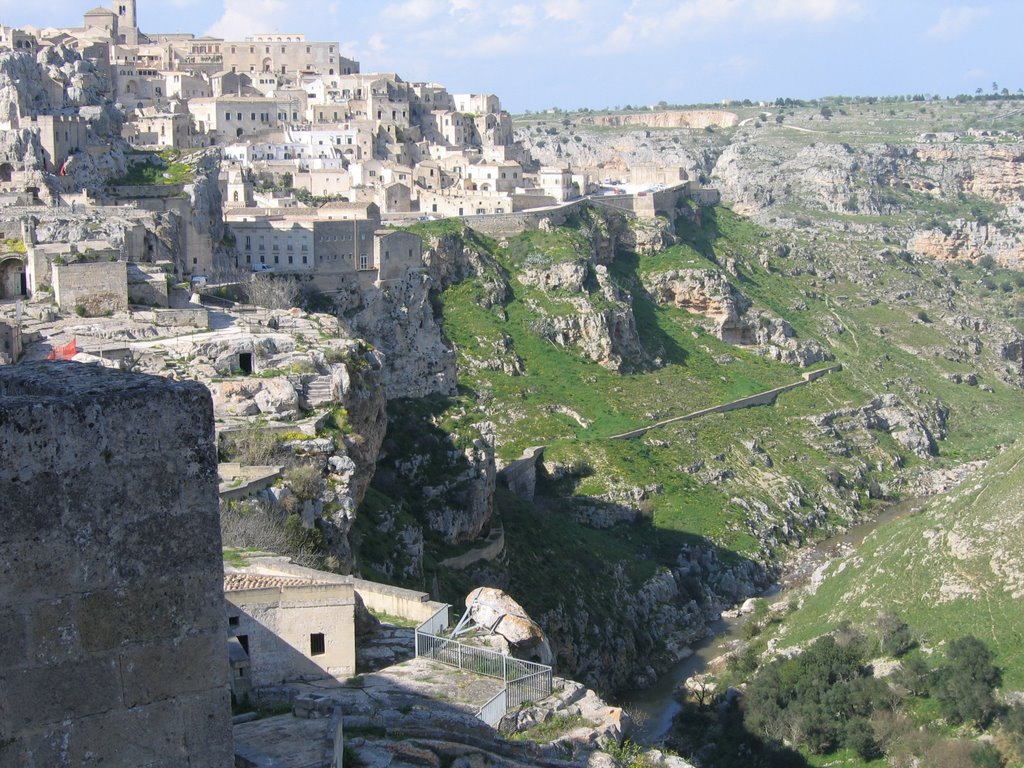
Another UNESCO site was the I Sassi di Matera. The first residents of these caves are thought to have dug their homes during the Paleolithic times. In the 1300’s this was a highly developed thriving community dug deep into the walls of the cliff. Chambers, lofts, storage areas, hallways and benches are carved from the stone and it is possible to imagine the energy of early apartment living. Churches and monasteries were also built in the same way with freschi painted on the rocks. During the time of Mussolini, running water and sewage systems were created, but due to high unemployment and the desire for that which is modern the residents moved to the “new city” in the 1930’s and many of the caves have been abandoned to garbage piles. The filming of “The Passion of Christ” was done here and some of the sections are now being restored as summer and weekend retreats.
This was definitely an eating drinking trip. People brought homemade wine and snops that was passed around the bus. At every stop the bottles and the food were pulled from bags and generously shared with everyone. We ate some of our meals at traditional restaurants sampling the cuisine and drinks of the region. I have never been too fond of bus tours, but this was a fabulous opportunity for me to get to know the teachers away from the schedule of school and build some lovely friendships that extend back to Nov Gorica.
In Monte Sant’Angelo we visit the hill top city where crusaders trained and received spiritual preparation before sailing from Bari to the holy land. The grotto under the church is believed to be the earthly home of the Archangel Michael and this was the second largest pilgrimage site after Rome during the middle ages. There were strong beliefs that the world would end in 1,000 so believers stopped creating and constructing in their home towns and traveled to holy sites to see the sacred relics before the end times. These pilgrimage roads leading from the British Isles to Italy intersected in France and the first tourist economy sprang up along these journey paths leading to the beautiful monasteries that housed the plunder brought back by the crusaders beginning in 195. One relic we experience on this trip is the house of Mary the mother of Jesus thought to have been brought to Italy by the angels. Actually it is a house made of stone, proven to be from the holy land from the time of Christ, that was brought by the D’Angelo family to preserve it from possession by the Muslims. It now sits within a basilica and is a place of unique smells and the feeling of warmth within the stonewalls.
Around 1,150, when it appeared that the world was not going to come to a fiery end, the faithful began to build churches in their hometowns with a focus on judgment and repentance. Those who had traveled to far exotic places brought back unusual ideas, stories of happenings and images of unusual creatures that can be seen in the designs of the churches and castles in Southern Italy. One such exotic building is the Castel del Monte, built by Frederic II between 1229 & 1249. It is a gigantic octagonal shaped hunting lodge that looms on the hill above the surrounding olive groves. The building is decorated with Eastern designs in doorways and windows carved from red aggregate, marble columns streaked with orange and trimmed with floral extensions, spiral stair cases and an upstairs indoor toilet.
In Bari, in the Basilica di San Nicola, the remains of St. Nicholas [of Christmas fame] are found. Stolen from Myra by Italian sailors in 1087 the remains have held a great fascination due to the continuous extraction of liquid manna from the bones. The presence of holy relics and people who come to worship in these places is fascinating to me. So many of the buildings are built on the Roman ruins of temples and the energy for centuries is one of seeking and believing. I find it difficult to understand the power of holy objects, but I bask in the seeking of things spiritual.
Outside of Bari we visit a producer of olive oil. Il Fratolo D’Amico processes totally biological olive oil with in 12 hours after picking the fruit from the trees. Many of the trees are ancient goddesses 3 – 400 years old standing watch within walled fields of flowers. The slow process grinds the olives by large stones. The lacrima, or the tears, pools on the pulp and is ladled in the first 10 minutes for the purest olive oil. Then the pulp is pressed on mesh discs for 4 hours and the oil that is extracted is extra virgin. The faster process grinds the olives with metal discs using centrifugal resulting in an oil of a much lower quality. I have never before tasted oil that tastes like the smell of freshly cut grass. I am definitely spoiled for life.
The place I found the most fascinating was Alberobello. This UNESCO [unesco.org] site is a community of trulli buildings, cone shaped houses, built in the ancient style of motarless construction. Legend says that the residents were able to dismantle their homes when the taxman came to avoid paying taxes on structures built on the king’s land. After he had passed, what appeared to be piles of rubble, the houses were reconstructed until the next visit. The streets weave around hobbit houses painted stark white with flat stone conical roofs capped with pieces bearing ancient symbols. The double walls are layers of flat rock over loose stone used for insulation. The interior is an even temperature all year, the walls are stuccoed and white washed with curtains separating the sparse rooms that were originally heated by the cooking fire. The children sleep in loft spaces closest to the rising warmth and water is stored in a cistern below the structure. Many of the buildings we saw are tourist shops, but the community consists of over a hundred homes that are lived in and lovingly maintained. This was once a thriving neighborhood of those who could afford no less, but now it is a prestigious place for a weekend home.
Another UNESCO site was the I Sassi di Matera. The first residents of these caves are thought to have dug their homes during the Paleolithic times. In the 1300’s this was a highly developed thriving community dug deep into the walls of the cliff. Chambers, lofts, storage areas, hallways and benches are carved from the stone and it is possible to imagine the energy of early apartment living. Churches and monasteries were also built in the same way with freschi painted on the rocks. During the time of Mussolini, running water and sewage systems were created, but due to high unemployment and the desire for that which is modern the residents moved to the “new city” in the 1930’s and many of the caves have been abandoned to garbage piles. The filming of “The Passion of Christ” was done here and some of the sections are now being restored as summer and weekend retreats.
This was definitely an eating drinking trip. People brought homemade wine and snops that was passed around the bus. At every stop the bottles and the food were pulled from bags and generously shared with everyone. We ate some of our meals at traditional restaurants sampling the cuisine and drinks of the region. I have never been too fond of bus tours, but this was a fabulous opportunity for me to get to know the teachers away from the schedule of school and build some lovely friendships that extend back to Nov Gorica.



Thursday, May 18, 2006


Wednesday, April 26, 2006
I traveled home to Ohio on 11 March to sing the Mozart Requiem with the Ashland Symphony and teach workshops as a Kennedy Center Teaching Artist for the state of Ohio, but mostly to visit with family and friends. I had no idea how it would feel to go home. Would I be so comforted by the familiar, the ease of understanding everything around me that I would never want to leave again? Or would the culture of excess and abundance disturb me so much that I would go running back to Slovenia? Actually I had neither response. It was indeed comforting to be able to understand announcements in the airport, read the signs and purchase a drink with words rather than waving and pointing hand signals, but now I also am able to understand all the conversations around me. Living in a country where I understand just a few words in each sentence has made it possible for me to pull in my antennas when I am in a crowd and contemplate my own thoughts rather than the thoughts of those around me [not that my thoughts are so profound, but at times they are more stimulating than conversations between couples or parents and young children]. But now that I am in the U.S. and everyone is speaking English loudly I am in the midst of everyone’s conversation. Like a magnet my thoughts bounce back and forth to the closest, loudest, most animated conversation until I have no thoughts of my own. It took me a distressingly long time to be able to block out all the nonsensical noise pollution
After two weeks of being at home I am still very confused. Home does not feel like home. It doesn’t feel foreign, but it also does not have the cozy comfort of home. The cities are lacking aesthetics, buildings are abandoned boarded up, trash is scattered along the sidewalks cluttering the grass and clogging the pours of the earth. Self-promotion blinds drivers on the roads and clutters the brain in restaurants, stores, magazines, T.V. and radio. Automobiles are enormous with only the driver in a vehicle expanded enough for seven. Music blares in elevators, stores, restaurants, competing with T.V. news and sports blasting over top of the deafening din so that we loose our voices trying to have pleasant meaningful conversation. Abundance over flows in the groceries, the clothing stores and the bookstores, bigger and more breeds so much waste that there are stores that practically give the clothes away. But it is an abundance of poor quality cheaply made garments lacking in style, quality, longevity and made by poor slaving women in developing nations. It is this cheap abundance that makes everyone in the U.S. capable of having much more than he/she needs. Does wealth lead to abundance – abundance to waste – waste to the aesthetic soulless poverty of the ugly?
Everywhere there is carryout food and drink, paper, plastic styrofoam surrounding nourishment consumed while driving, watching T.V. , dashing in a hurry. Food is simply for sustenance enhanced with salt, fat, and sugar so that it very quickly becomes unhealthy. Carryout is not even a concept that has been realized in Slovenia. Yes you can get pizza delivery, but to eat on the run is unheard of. So people include healthy food consumption together as a part of their day along with having a coffee with friends.
On an Ohio brilliant sunny blue-sky day, sidewalks are empty of walkers and in new consumer areas no one is expected to walk so the investment has not even been made in sidewalks. Drivers circle parking lots diving for the closest parking space rather than walking while concrete bleeds over the earth blocking the breath of the world. What saddens me the most is that these unhealthy manifestations of our American culture is the way the rest of the world seems to be judging themselves and they are desperately destroying their own countries to live up to our standard.
Yet in the U.S. people are more pleasant. They greet strangers on the street with a smile, a hello. They make room for others on the sidewalk or adjust their pace to accommodate someone else in their space. They talk and make jokes in an elevator and make eye contact with strangers. Americans show their private face and personality in public while the Slovenes seem to be very selective as to whom they open up to. The Slovenes are not as unfriendly as them seem, they are just much more cautious and selective than Americans.
There is also so much more diversity in the U.S. People on the streets have faces from all over the world. Food from all cultures can be enjoyed in restaurants and purchased at common grocery stores and the diversity, despite the problems, provides the U.S. with a cultural richness unknown to Slovenes.
Priorities seem to be different too. For many people I know in Ohio the priorities appear to be listed as: 1. Work 2. Family 3. Religion 4. House/yard care 5. Friends 6. Leisure time. In Slovenia the list appears to be: 1. Family 2. Friends 3. Leisure time 4. Work 5. House/yard care and religion is a part of the week for some, but it does not appear to be the same kind of social activity. Cultural priorities determine much about the way people interact with each other, how their cities are designed and how they respond to their world. In Slovenia shopping is not a leisure time activity, but hiking in the woods, on the bike path or strolling along the city sidewalks is. Therefore the U.S. has far too many shopping malls and the Slovenes have hiking paths everywhere. How wonderful that Bob and I have the opportunity to live where the collective priority list is closer to our personal list.
After two weeks of being at home I am still very confused. Home does not feel like home. It doesn’t feel foreign, but it also does not have the cozy comfort of home. The cities are lacking aesthetics, buildings are abandoned boarded up, trash is scattered along the sidewalks cluttering the grass and clogging the pours of the earth. Self-promotion blinds drivers on the roads and clutters the brain in restaurants, stores, magazines, T.V. and radio. Automobiles are enormous with only the driver in a vehicle expanded enough for seven. Music blares in elevators, stores, restaurants, competing with T.V. news and sports blasting over top of the deafening din so that we loose our voices trying to have pleasant meaningful conversation. Abundance over flows in the groceries, the clothing stores and the bookstores, bigger and more breeds so much waste that there are stores that practically give the clothes away. But it is an abundance of poor quality cheaply made garments lacking in style, quality, longevity and made by poor slaving women in developing nations. It is this cheap abundance that makes everyone in the U.S. capable of having much more than he/she needs. Does wealth lead to abundance – abundance to waste – waste to the aesthetic soulless poverty of the ugly?
Everywhere there is carryout food and drink, paper, plastic styrofoam surrounding nourishment consumed while driving, watching T.V. , dashing in a hurry. Food is simply for sustenance enhanced with salt, fat, and sugar so that it very quickly becomes unhealthy. Carryout is not even a concept that has been realized in Slovenia. Yes you can get pizza delivery, but to eat on the run is unheard of. So people include healthy food consumption together as a part of their day along with having a coffee with friends.
On an Ohio brilliant sunny blue-sky day, sidewalks are empty of walkers and in new consumer areas no one is expected to walk so the investment has not even been made in sidewalks. Drivers circle parking lots diving for the closest parking space rather than walking while concrete bleeds over the earth blocking the breath of the world. What saddens me the most is that these unhealthy manifestations of our American culture is the way the rest of the world seems to be judging themselves and they are desperately destroying their own countries to live up to our standard.
Yet in the U.S. people are more pleasant. They greet strangers on the street with a smile, a hello. They make room for others on the sidewalk or adjust their pace to accommodate someone else in their space. They talk and make jokes in an elevator and make eye contact with strangers. Americans show their private face and personality in public while the Slovenes seem to be very selective as to whom they open up to. The Slovenes are not as unfriendly as them seem, they are just much more cautious and selective than Americans.
There is also so much more diversity in the U.S. People on the streets have faces from all over the world. Food from all cultures can be enjoyed in restaurants and purchased at common grocery stores and the diversity, despite the problems, provides the U.S. with a cultural richness unknown to Slovenes.
Priorities seem to be different too. For many people I know in Ohio the priorities appear to be listed as: 1. Work 2. Family 3. Religion 4. House/yard care 5. Friends 6. Leisure time. In Slovenia the list appears to be: 1. Family 2. Friends 3. Leisure time 4. Work 5. House/yard care and religion is a part of the week for some, but it does not appear to be the same kind of social activity. Cultural priorities determine much about the way people interact with each other, how their cities are designed and how they respond to their world. In Slovenia shopping is not a leisure time activity, but hiking in the woods, on the bike path or strolling along the city sidewalks is. Therefore the U.S. has far too many shopping malls and the Slovenes have hiking paths everywhere. How wonderful that Bob and I have the opportunity to live where the collective priority list is closer to our personal list.

Saturday, March 11, 2006


Friday, March 10, 2006
Winter Holiday
Bob had winter holiday the last part of February and we combined that with our annual wedding anniversary trip and set of for Tuscany. The train ride to Florence from Gorizia, Italy is 5 ½ hours with a transfer in Udine. We were amazed that so many people were riding the train. Every seat was taken with families, workers, business types, and elderly ladies alone, but very few non-Italians. Bob’s fascination with trains and train travel is heightened every time we travel. There are no high-speed bullet trains like in France, but the coaches are comfortable and the views are beautiful. We have not had this problem ourselves, but we know of people who have forgotten to stamp their tickets before entering the train and they have had to pay an additional fare on the train, so we are constantly reminding each other to punch the ticket in the little orange box on the platform.
I was 19 years old the last time I visited. The advantage of ancient Italian cities is that they don’t change much over the years, but the city did seem busier with more cars, more modern businesses and high scale shops than I remember. I think maybe the changes have been mine. We heard more American English in Florence than we have heard in the past 6 months. Many American universities have study abroad programs in Florence and their presence has been an assistance to the Florentine economy. The universities have purchased buildings for classes and provided apartments for their students, and of course the students are out and about spending money on eating, playing and other necessities of living in an historical community. Their presence is really evident with the number of carryout pizza deli’s and racks of potato chips with cold cokes.
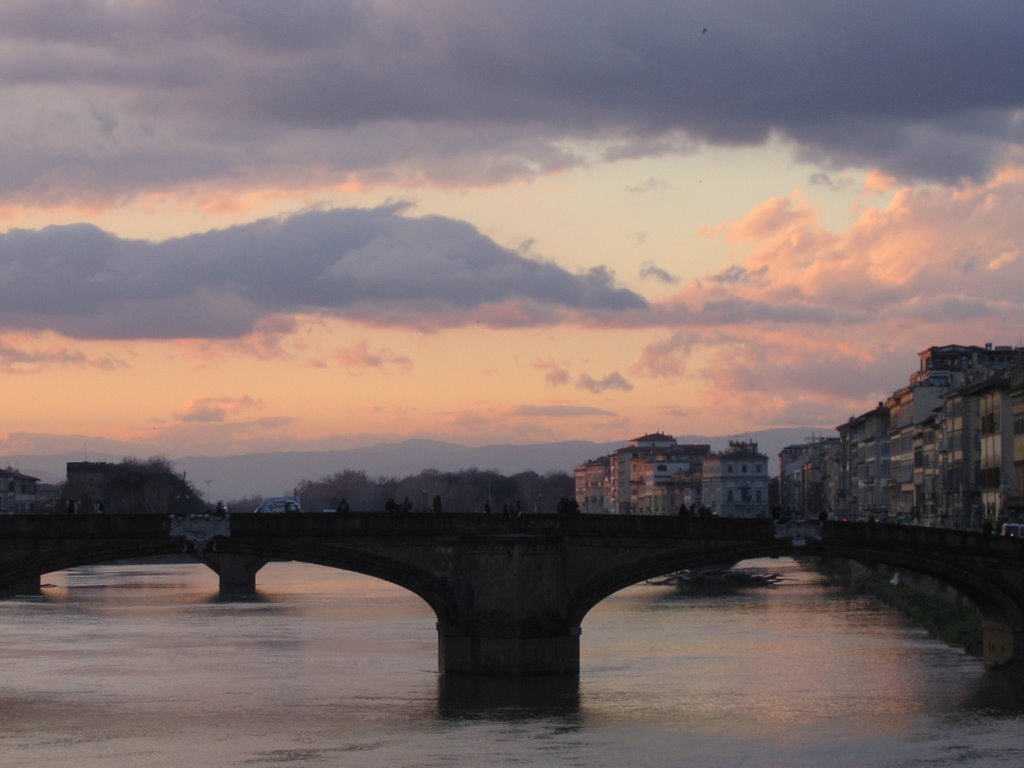
We stayed just outside the old walls of the city, an easy walk to the Duomo and other attractions. We spent a long time just wandering the city, watching the sunsets over the Arno river from the Ponte Vecchio, peering into doorways that lead to hidden gardens and courtyards, entering churches that have been standing for 800 years and glancing at the tourist wares in the market. If I more than glanced in the market I was accosted by the sellers throwing out multiple languages until I reacted, and then they tried to charm me in perfect English.
We attended morning Ash Wednesday mass in the Duomo with 60 other s in a church built to seat thousands. As much as I am pulled to visit churches when I travel, the experience of sharing the intention of the building is much more meaningful than walking through as if in a museum. The vision and devotion of the faithful echoes and dances in the walls of a church and their energy is much more present when joined with others seeking the Spirit. The search for understanding of the spiritual is everywhere in ancient Florence; in the altars set high in the corner of buildings, in the frescoes that cover the walls of every church, in the paintings that decorate the walls and the sculpture that are housed in the niches.
A space that really spoke to me in an ancient tongue was the courtyard of the confraternity of Il Chriostro dello Scalzo on via Cavour. A doorway like so many others leads into a courtyard enclosed with a skylight illuminating drawings of the life of John the Baptist on the walls. The fresco images were created during the years 1509 – 1526 and have the look of monochromatic oil pastel. The figures reflect the honest look of the people of the time; faces with wrinkles, double chins and tired eyes. So many of the glorious paintings we see in other spaces are the aggrandizement of the body or the soul of the individual. The holy faces have a classic beauty, sculpted perfection or the nearly naked bodies are the study of the muscular structure, but here in this little hidden wonder the people of the countryside 500 years ago look out from their pensive thoughts and daily happenings.
We had an early morning viewing of Michelagelo’s David alone in the Accademia; there are no lines at 8:15am. The enormity and the beauty of that sculpture are breathtaking, but I delight even more in the unfinished pieces and the struggle of the lives trying to free themselves from the rock. I have read and reread The Agony and the Ecstasy by Irving Stone. In his recreation of the life of Michelangelo the young sculptor broke from tradition and chose the piece of marble by the life he saw within the stone. These souls forever jailed in stone rage against their captivity are calling to be freed 500 years after they were first discovered. Also in this museum is the first pianoforte made by Christopho in 1700. While in the employ as a court musician of the Medici he created this new instrument to be able to control the dynamics of his playing. The first instrument has not been restored and is in the same condition it was when it was found in a 20th century attic.
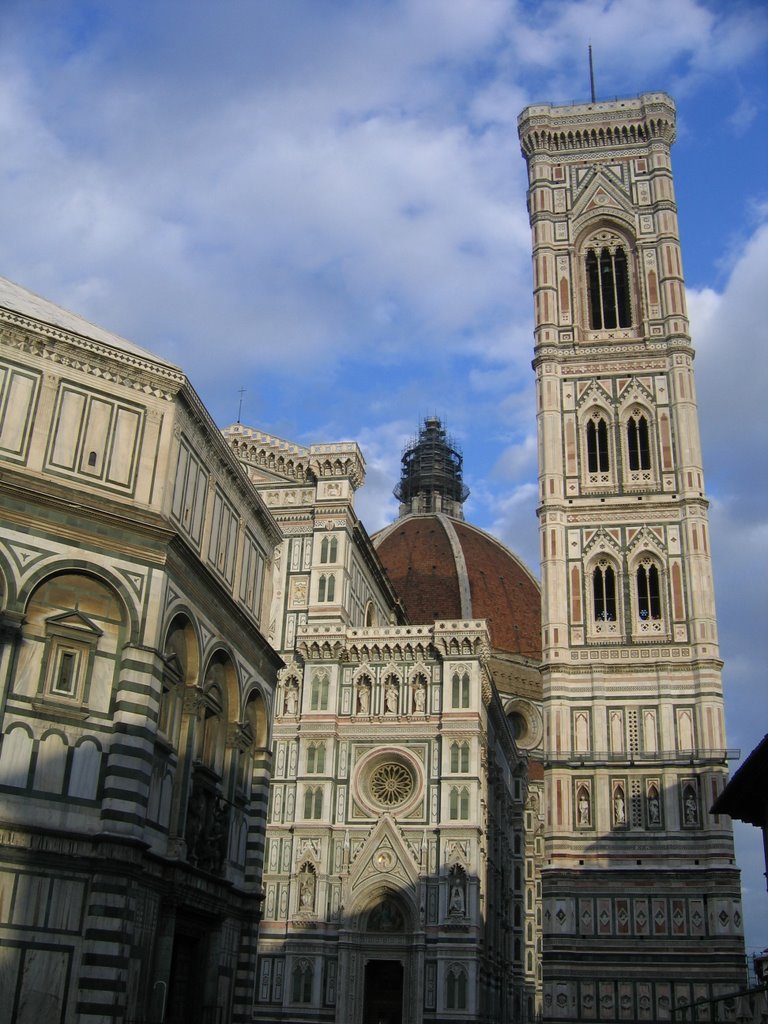
There are so many churches around the city with brown block undecorated fronts. We were confused as to why they looked unfinished. The holes for the scaffolding were left open and now house the pigeons when it rains. Was this the result of WWII destruction? All the bridges except the Arno were destroyed, could the facades of the churches been damaged too? A visit to the Museo dell’Opera del Duomo helped us understand that the churches took forever to complete and some still remain naked and unfinished. The façade of Santa Maria del Fiore – the Duomo, looked the same until the end of the 19th century. The cathedral was begun in the 13th century on the site of an existing church that continued to serve the parish while the Duomo was being built around it. The lower portion of the façade was completed, but left unfinished until the 1580’s when the Medici’s had it removed with the intent of completing the façade. It remained unfinished until the design of Emil de Fabris was chosen in the 1800’s and it was completed in 1887. The museum shows the designs that were proposed over the years and the drawings of other submissions that competed with the Fabis design. In addition to viewing the original art that was created for the Duomo the study of the evolution of the building is fascinating.
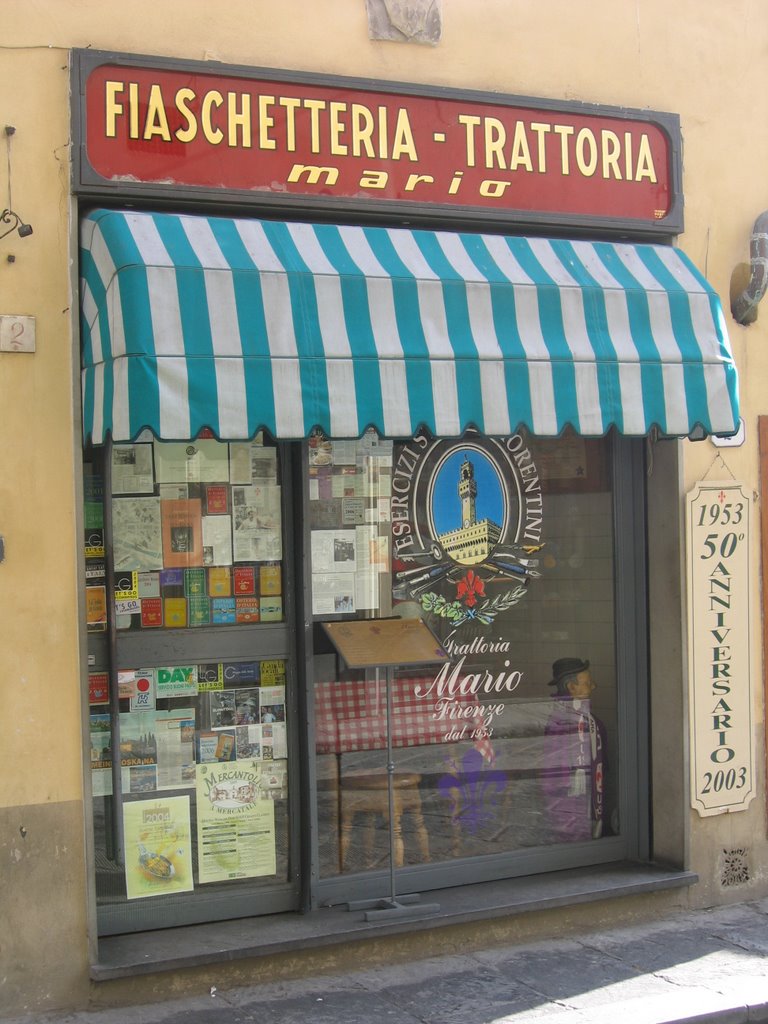
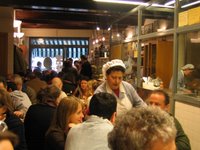
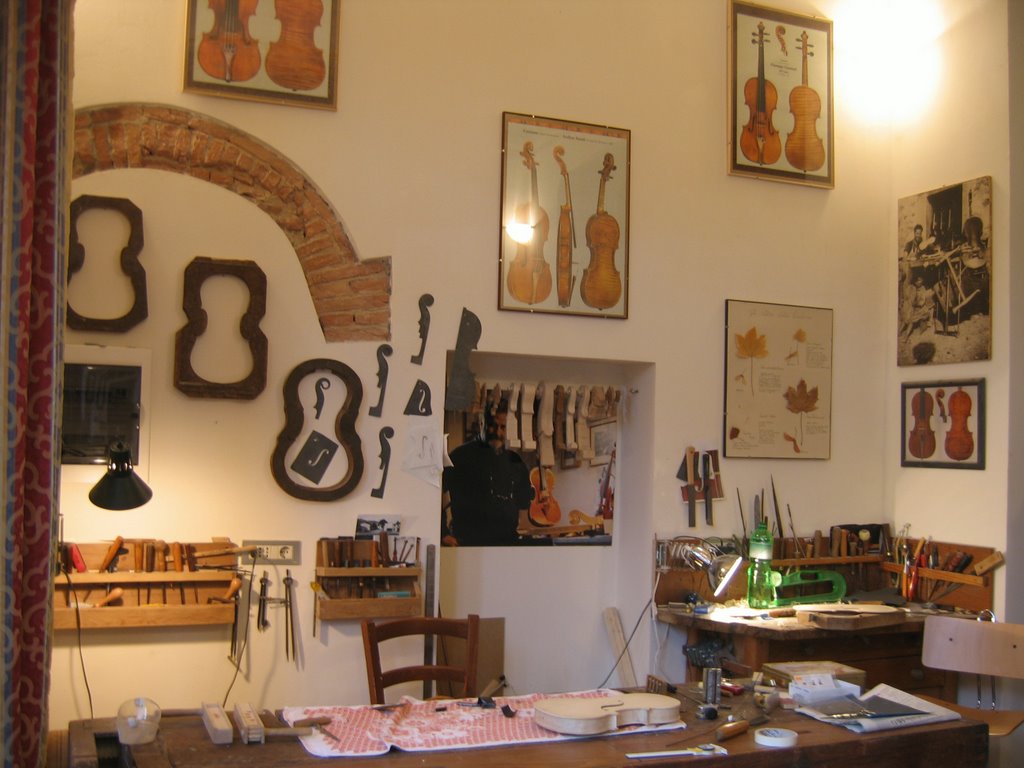
A high light of the trip was visiting the violin workshop of Paolo Vettori e Figli. We met Paolo and Milica in Nova Gorica and visited them in their new location near to our hotel and across the street from the sculpture garden where Michelangelo worked. Paolo, Dario, and Lapo create around two dozen hand made instruments each year using ancient wood rescued from an old barn. They have restored the carriage house of an old palace for the workshop and show room. Their vision to mold this space to meet their needs included digging a basement room from the inside. It was done mostly by hand with shovel and buckets filling 80 trucks with rubble. The front room where Dario and Lapo work has a sunny ceiling painting, large front wall of glass, a spiral staircase to the loft and the new basement and a window that opens to the back garden courtyard. They have molds and designs mounted on the walls, a glass showcase of recently made instruments and very very fine spruce dust everywhere from the detail finishing with tiny thumb planes and 1200 grade fine sand paper. We went to Fiaschetteria-Trattoria Mario for lunch. This typical Florentine local restaurant has been serving home cooked meals since 1953. The space is crowded with tables, the cooking happens behind a glass wall in plain view, regulars greet the family cooks by name, tourists watch wide eyed as this circus of serving delicious and fast lunches unfolds in record speed with the song of laughter everywhere. Bob shared a Florentine steak with the Vettori family and melted with the taste of the biggest hunk of rare meat I have ever seen at table. He couldn’t stop saying how wonderful it tasted. I enjoyed the prima course of pasta and then salad, grilled peppers, potatoes, local wine and finished with biscotti dipped in a liqueur and a light fluffy Florentine cake [I think all the traditional foods are called Florentine]. The bread in Florence though has great texture, but a very bland taste, no salt. Like everything else in Florence there is history in the bread too. 800 years ago Pisa was a port city because the Arno was wide and deep enough for sea vessels to travel. The tariffs on salt imposed by the Pisans were so high that the Florentines refused to buy the salt and therefore began making bread without salt. Now 800 years later the tradition continues. For those of us who are fascinated by tradition it oozes from every pour of this city.
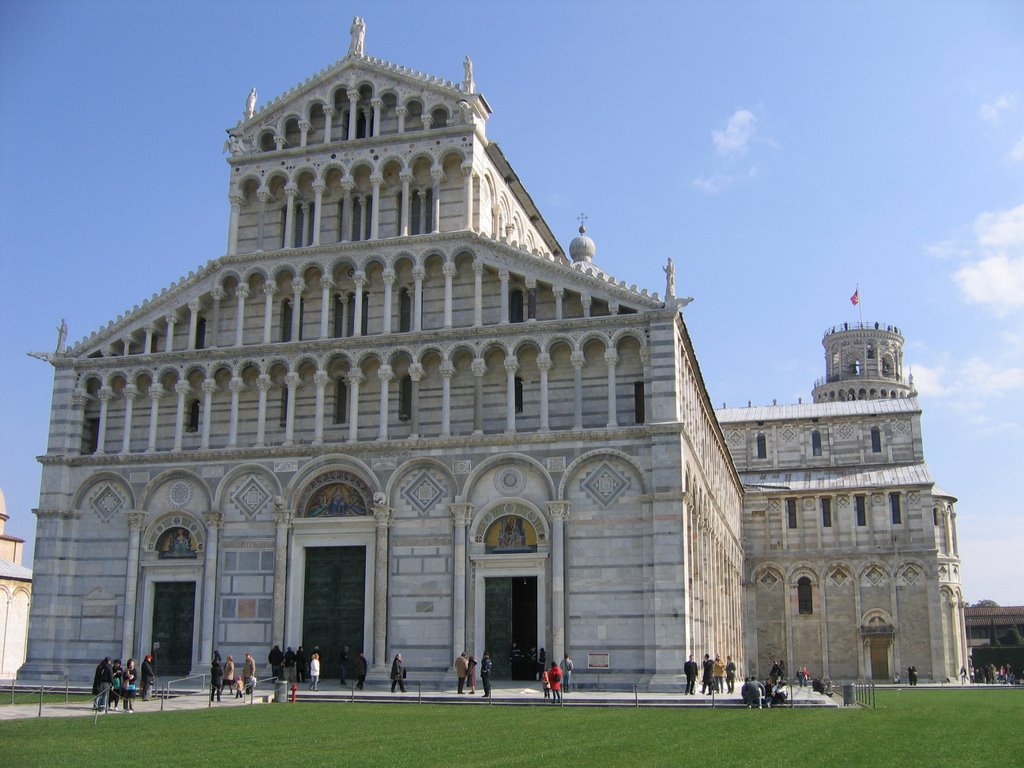
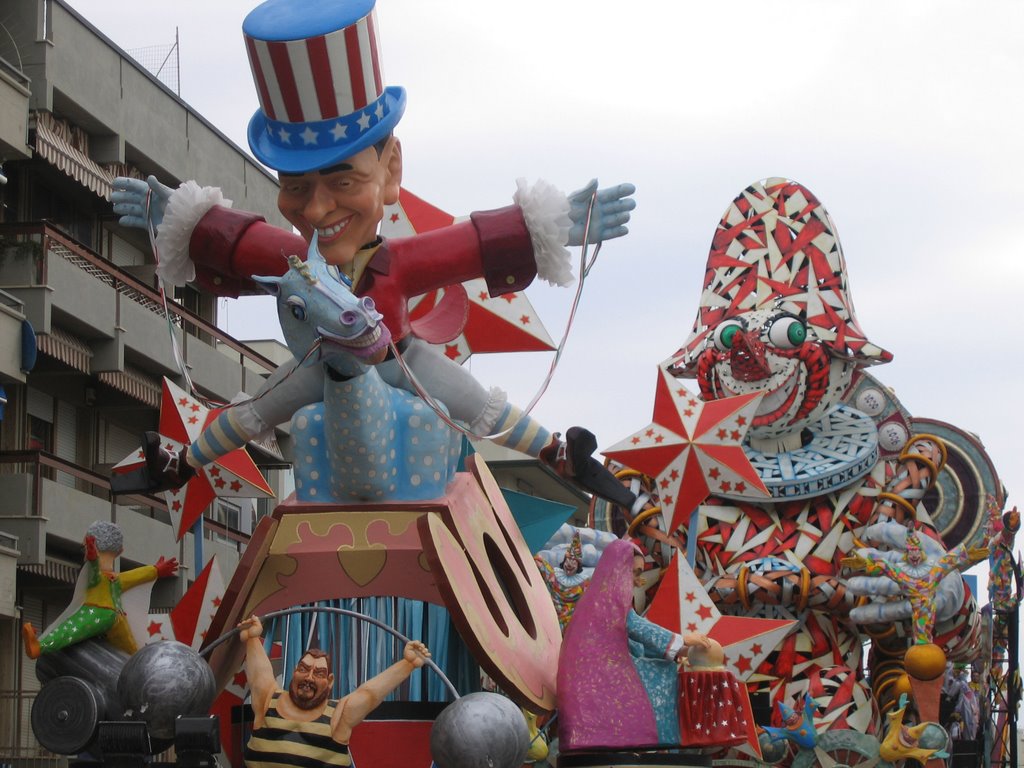
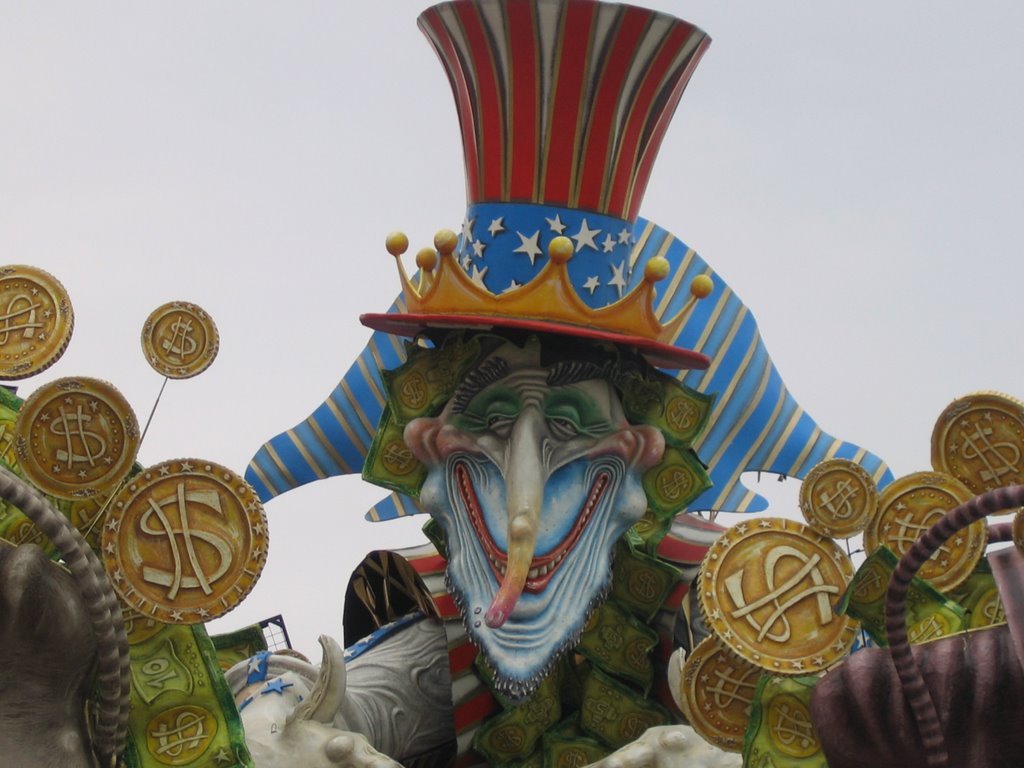
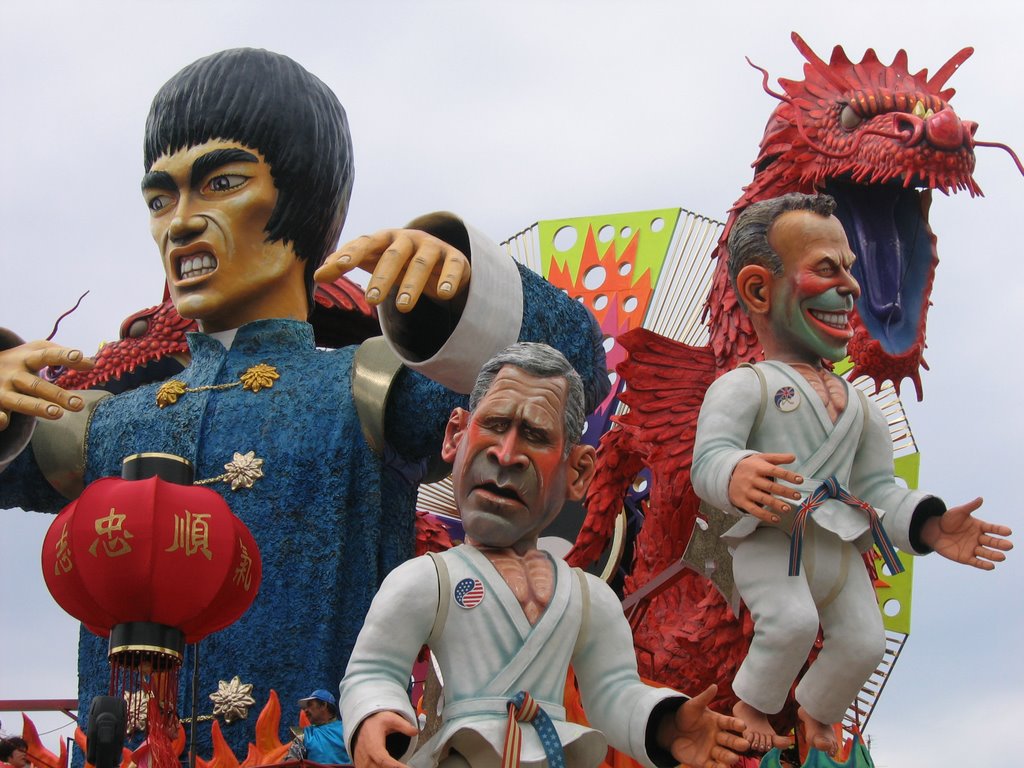
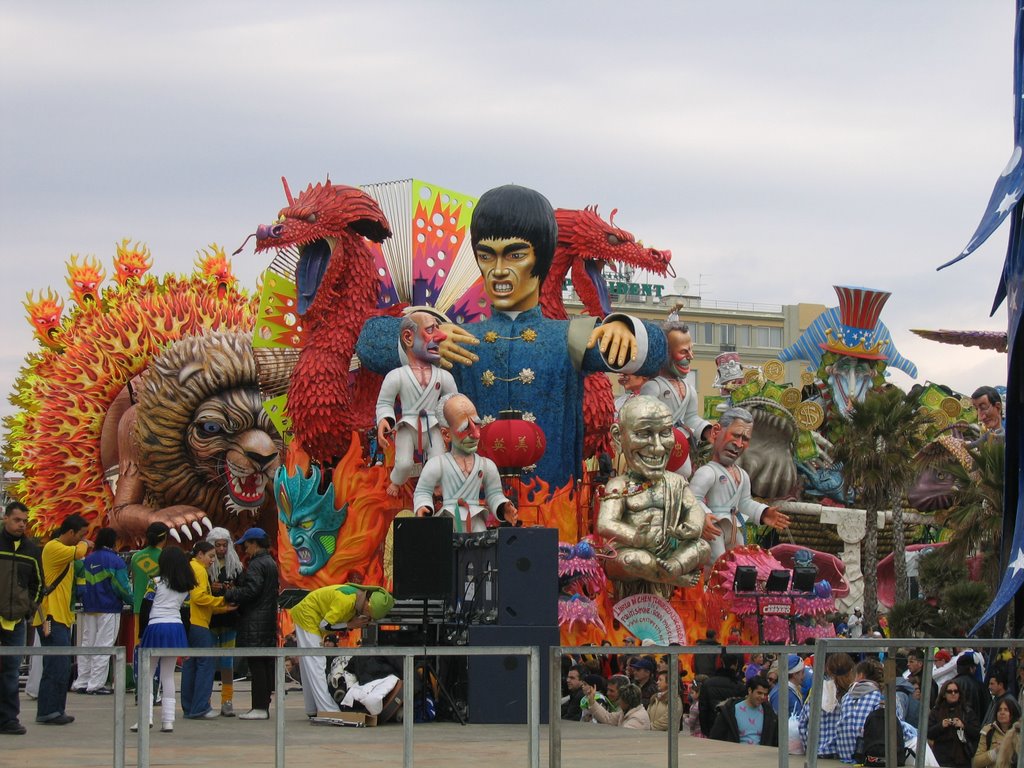
On Shrove Tuesday we traveled by train to Pisa and then to Viareggio. The best thing about Pisa is that the tower still leans and tourists come to see and feel the amazing energy within these walls. The crystal white buildings shimmer in the sun framed by the royal green grass and the rough blocks of the city walls. We then trained to Viareggio for the carnievale and the gigantic parade of floats. The city is a beach town on the Mediterranean coast with miles and miles of soft sandy beach. The parade takes place on the street along the beach and people gathered are in a rich array of costumes. There were none of the wealthy elaborate costumes of Venice, but many families were adorned with funny hats, masks, glasses and silly costumes. Most of the floats had national and international political statements. The face of George W. was clearly the most popular image with strong statements about American politics.
We greatly enjoy going to places in Italy, but the Slovenes we know are not as excited about things Italian. In this area where the fascists had control for 25 years the people still have long resentments that their names were changed, that they were not allowed to speak their own language and that the Italians were awarded cities and land that had always been traditionally Slovene. Some boys at school were telling Bob that when the Slovenian partisans were fighting WWII in this area they could have moved further into Italy, but because of natural and cultural borders they chose to stay in the area where Slavic languages were spoken, but that consideration was not given to the people when the allies drew the boundaries. Resentments live on for generations.
Bob had winter holiday the last part of February and we combined that with our annual wedding anniversary trip and set of for Tuscany. The train ride to Florence from Gorizia, Italy is 5 ½ hours with a transfer in Udine. We were amazed that so many people were riding the train. Every seat was taken with families, workers, business types, and elderly ladies alone, but very few non-Italians. Bob’s fascination with trains and train travel is heightened every time we travel. There are no high-speed bullet trains like in France, but the coaches are comfortable and the views are beautiful. We have not had this problem ourselves, but we know of people who have forgotten to stamp their tickets before entering the train and they have had to pay an additional fare on the train, so we are constantly reminding each other to punch the ticket in the little orange box on the platform.
I was 19 years old the last time I visited. The advantage of ancient Italian cities is that they don’t change much over the years, but the city did seem busier with more cars, more modern businesses and high scale shops than I remember. I think maybe the changes have been mine. We heard more American English in Florence than we have heard in the past 6 months. Many American universities have study abroad programs in Florence and their presence has been an assistance to the Florentine economy. The universities have purchased buildings for classes and provided apartments for their students, and of course the students are out and about spending money on eating, playing and other necessities of living in an historical community. Their presence is really evident with the number of carryout pizza deli’s and racks of potato chips with cold cokes.
We stayed just outside the old walls of the city, an easy walk to the Duomo and other attractions. We spent a long time just wandering the city, watching the sunsets over the Arno river from the Ponte Vecchio, peering into doorways that lead to hidden gardens and courtyards, entering churches that have been standing for 800 years and glancing at the tourist wares in the market. If I more than glanced in the market I was accosted by the sellers throwing out multiple languages until I reacted, and then they tried to charm me in perfect English.
We attended morning Ash Wednesday mass in the Duomo with 60 other s in a church built to seat thousands. As much as I am pulled to visit churches when I travel, the experience of sharing the intention of the building is much more meaningful than walking through as if in a museum. The vision and devotion of the faithful echoes and dances in the walls of a church and their energy is much more present when joined with others seeking the Spirit. The search for understanding of the spiritual is everywhere in ancient Florence; in the altars set high in the corner of buildings, in the frescoes that cover the walls of every church, in the paintings that decorate the walls and the sculpture that are housed in the niches.
A space that really spoke to me in an ancient tongue was the courtyard of the confraternity of Il Chriostro dello Scalzo on via Cavour. A doorway like so many others leads into a courtyard enclosed with a skylight illuminating drawings of the life of John the Baptist on the walls. The fresco images were created during the years 1509 – 1526 and have the look of monochromatic oil pastel. The figures reflect the honest look of the people of the time; faces with wrinkles, double chins and tired eyes. So many of the glorious paintings we see in other spaces are the aggrandizement of the body or the soul of the individual. The holy faces have a classic beauty, sculpted perfection or the nearly naked bodies are the study of the muscular structure, but here in this little hidden wonder the people of the countryside 500 years ago look out from their pensive thoughts and daily happenings.
We had an early morning viewing of Michelagelo’s David alone in the Accademia; there are no lines at 8:15am. The enormity and the beauty of that sculpture are breathtaking, but I delight even more in the unfinished pieces and the struggle of the lives trying to free themselves from the rock. I have read and reread The Agony and the Ecstasy by Irving Stone. In his recreation of the life of Michelangelo the young sculptor broke from tradition and chose the piece of marble by the life he saw within the stone. These souls forever jailed in stone rage against their captivity are calling to be freed 500 years after they were first discovered. Also in this museum is the first pianoforte made by Christopho in 1700. While in the employ as a court musician of the Medici he created this new instrument to be able to control the dynamics of his playing. The first instrument has not been restored and is in the same condition it was when it was found in a 20th century attic.
There are so many churches around the city with brown block undecorated fronts. We were confused as to why they looked unfinished. The holes for the scaffolding were left open and now house the pigeons when it rains. Was this the result of WWII destruction? All the bridges except the Arno were destroyed, could the facades of the churches been damaged too? A visit to the Museo dell’Opera del Duomo helped us understand that the churches took forever to complete and some still remain naked and unfinished. The façade of Santa Maria del Fiore – the Duomo, looked the same until the end of the 19th century. The cathedral was begun in the 13th century on the site of an existing church that continued to serve the parish while the Duomo was being built around it. The lower portion of the façade was completed, but left unfinished until the 1580’s when the Medici’s had it removed with the intent of completing the façade. It remained unfinished until the design of Emil de Fabris was chosen in the 1800’s and it was completed in 1887. The museum shows the designs that were proposed over the years and the drawings of other submissions that competed with the Fabis design. In addition to viewing the original art that was created for the Duomo the study of the evolution of the building is fascinating.
A high light of the trip was visiting the violin workshop of Paolo Vettori e Figli. We met Paolo and Milica in Nova Gorica and visited them in their new location near to our hotel and across the street from the sculpture garden where Michelangelo worked. Paolo, Dario, and Lapo create around two dozen hand made instruments each year using ancient wood rescued from an old barn. They have restored the carriage house of an old palace for the workshop and show room. Their vision to mold this space to meet their needs included digging a basement room from the inside. It was done mostly by hand with shovel and buckets filling 80 trucks with rubble. The front room where Dario and Lapo work has a sunny ceiling painting, large front wall of glass, a spiral staircase to the loft and the new basement and a window that opens to the back garden courtyard. They have molds and designs mounted on the walls, a glass showcase of recently made instruments and very very fine spruce dust everywhere from the detail finishing with tiny thumb planes and 1200 grade fine sand paper. We went to Fiaschetteria-Trattoria Mario for lunch. This typical Florentine local restaurant has been serving home cooked meals since 1953. The space is crowded with tables, the cooking happens behind a glass wall in plain view, regulars greet the family cooks by name, tourists watch wide eyed as this circus of serving delicious and fast lunches unfolds in record speed with the song of laughter everywhere. Bob shared a Florentine steak with the Vettori family and melted with the taste of the biggest hunk of rare meat I have ever seen at table. He couldn’t stop saying how wonderful it tasted. I enjoyed the prima course of pasta and then salad, grilled peppers, potatoes, local wine and finished with biscotti dipped in a liqueur and a light fluffy Florentine cake [I think all the traditional foods are called Florentine]. The bread in Florence though has great texture, but a very bland taste, no salt. Like everything else in Florence there is history in the bread too. 800 years ago Pisa was a port city because the Arno was wide and deep enough for sea vessels to travel. The tariffs on salt imposed by the Pisans were so high that the Florentines refused to buy the salt and therefore began making bread without salt. Now 800 years later the tradition continues. For those of us who are fascinated by tradition it oozes from every pour of this city.
On Shrove Tuesday we traveled by train to Pisa and then to Viareggio. The best thing about Pisa is that the tower still leans and tourists come to see and feel the amazing energy within these walls. The crystal white buildings shimmer in the sun framed by the royal green grass and the rough blocks of the city walls. We then trained to Viareggio for the carnievale and the gigantic parade of floats. The city is a beach town on the Mediterranean coast with miles and miles of soft sandy beach. The parade takes place on the street along the beach and people gathered are in a rich array of costumes. There were none of the wealthy elaborate costumes of Venice, but many families were adorned with funny hats, masks, glasses and silly costumes. Most of the floats had national and international political statements. The face of George W. was clearly the most popular image with strong statements about American politics.
We greatly enjoy going to places in Italy, but the Slovenes we know are not as excited about things Italian. In this area where the fascists had control for 25 years the people still have long resentments that their names were changed, that they were not allowed to speak their own language and that the Italians were awarded cities and land that had always been traditionally Slovene. Some boys at school were telling Bob that when the Slovenian partisans were fighting WWII in this area they could have moved further into Italy, but because of natural and cultural borders they chose to stay in the area where Slavic languages were spoken, but that consideration was not given to the people when the allies drew the boundaries. Resentments live on for generations.

Sunday, February 26, 2006



The beginning of Spring in Slovenia.
It is time to celebrate the end of winter and the beginning of the Lenten season. Buds on trees and bushes are beginning to pulse and swell and everywhere there are preparations for Carnival. In Slovenia the celebration is called Pust based on pre-Christian traditions of driving the winter away to allow room for the spring to come rolling in. There are a variety of celebrations around the country each with its own traditions and costumes. The celebrations culminate on Shrove Tuesday where many of the floats and costumes are burned along with the negative bad feelings from the past year. Then after Ash Wednesday people fast [post] giving up the fatty foods and meats that kept them warm in the winter and prepare their hearts, souls and gardens for new life.
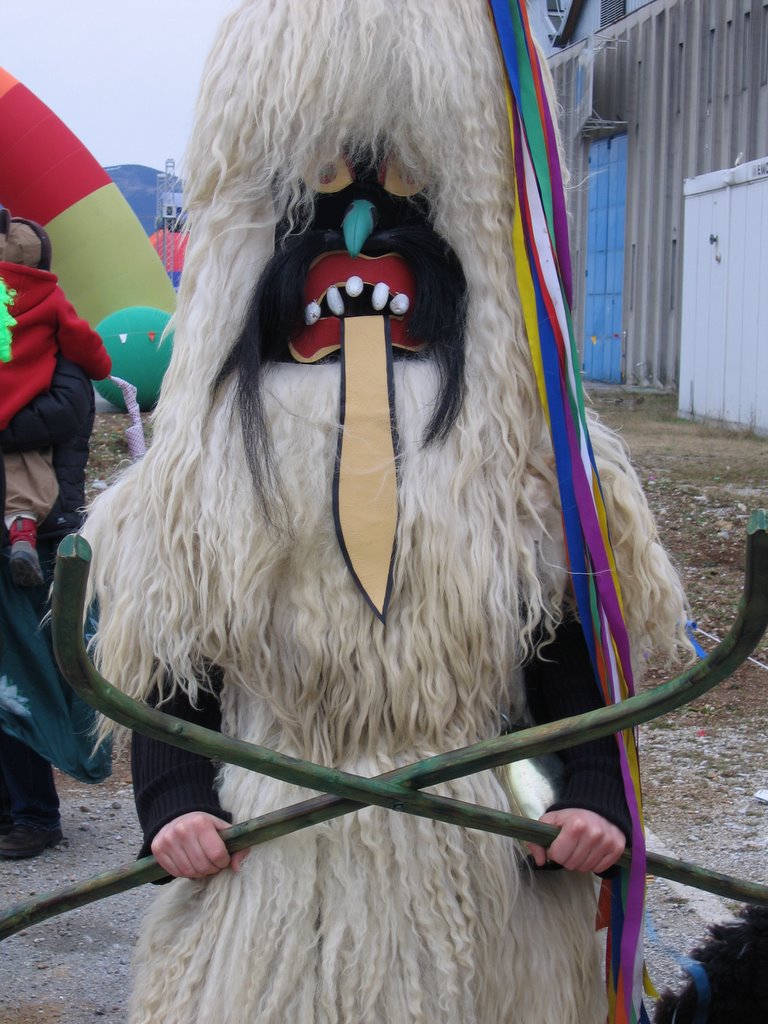
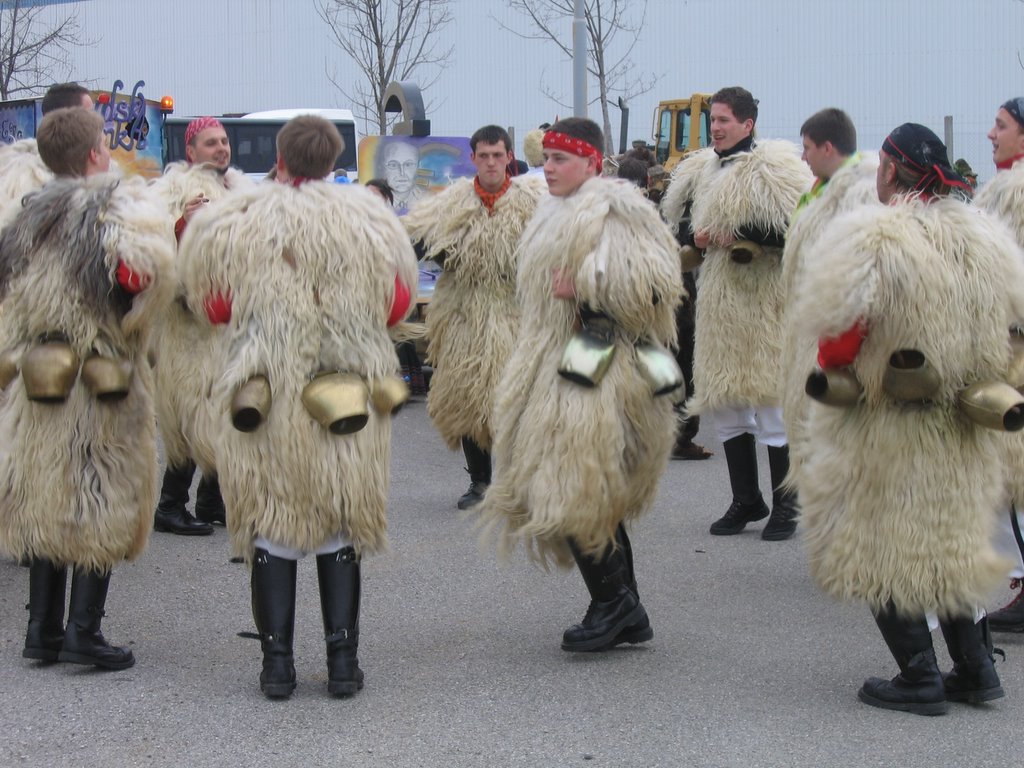
The Kurenti, which at one time were believed to have the power to chase away winter and usher in spring, are the central figures of the annual Kurentovanje festival.
The Slovenian rite of spring and fertility is called Kurentovanje. This event is celebrated for 10 days. Although the origins of Kurentovanje festivities are obscure, the celebration may have come from earlier Slavic, Celtic or Illyrian customs. Similar traditions are found throughout Central Europe in parts of Croatia, Hungary, Serbia, Bulgaria and elsewhere.
Kurentovanje is a distinctive pre-Lenten festival. The name comes from the festival's central figure, the Kurent, who in earlier times was believed to have the power to chase away winter and usher in spring. During this extravagant festival, Kurent, the god of unrestrained pleasure and hedonism, comes to life. Groups of Kurents (kurenti) dress in sheepskins with cowbells hanging from their belts. They wear furry caps decorated with horns, streamers, feathers and sticks.
The Kurent mask is a major work of folk art in Slovenia. The masks are made of leather, with two holes cut out for the eyes, and a single hole cut out for the mouth. The holes are surrounded with red paint. A trunk-like nose is attached, along with whiskers made of twigs and teeth made of white beans. The final touch is a long, red tongue which dangles down to the chest.
The Kurents travel throughout the town, moving from house to house to scare off evil spirits with bells and wooden clubs that are topped with hedgehog spines. A devil acts as the leader of the procession. He is covered in a net to catch souls. The Kurents are presented with the handkerchiefs of young girls. These gifts are attached to their belts. The people of the town smash clay pots at the feet of the Kurents for good luck and good health.
This info came from www.snpj.org. We attempeted to go to Ptuj where they have the largest Kurent festival, but the bus connections made it impossible to get there. We will try another year when we have a car. In other festivals the creatures paint their bodies green using leaves and growing things as decorations with bells to scare away the winter. These festivals are accompanied by costume parades, little children begging for candy from house to house, playing tricks on people and lots of parties with good food freshly made sausage and salami, and flansiti [a delicately thin fried pastry similar to elephant ears at the fair]. I went to the Karnival parade in ^Sempeter and there young men were dressed in the kurent costumes along with floats that made political statements about bird flu, the introduction of the Euro next year and the mayor who was being accused of being a gypsy.
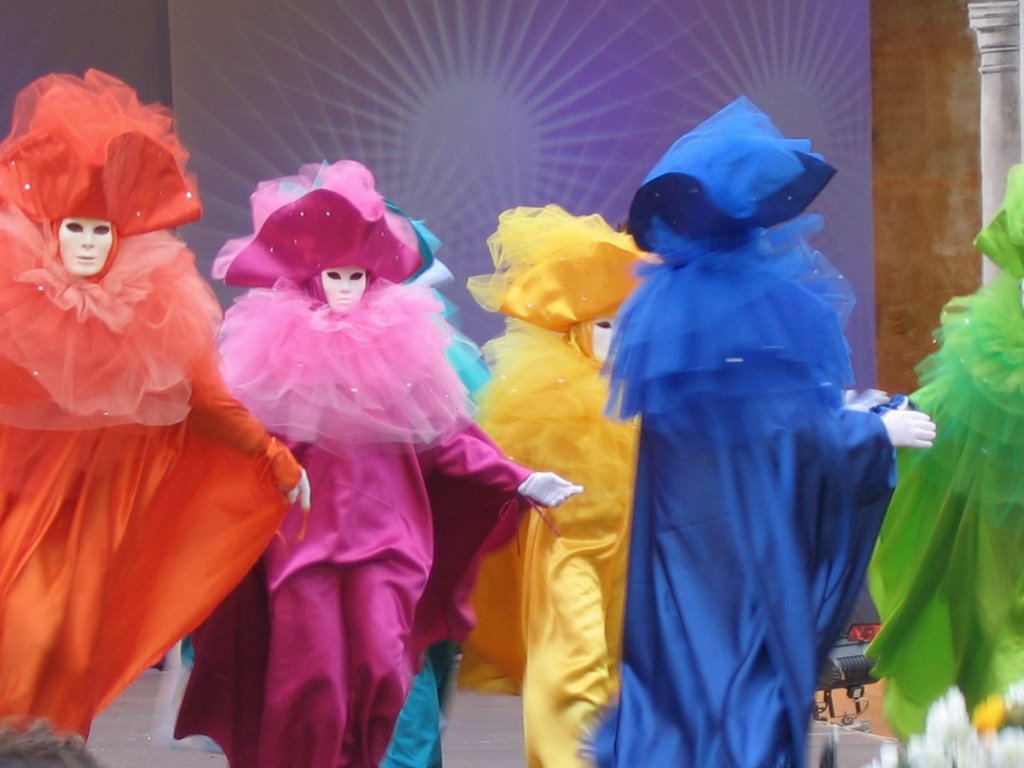
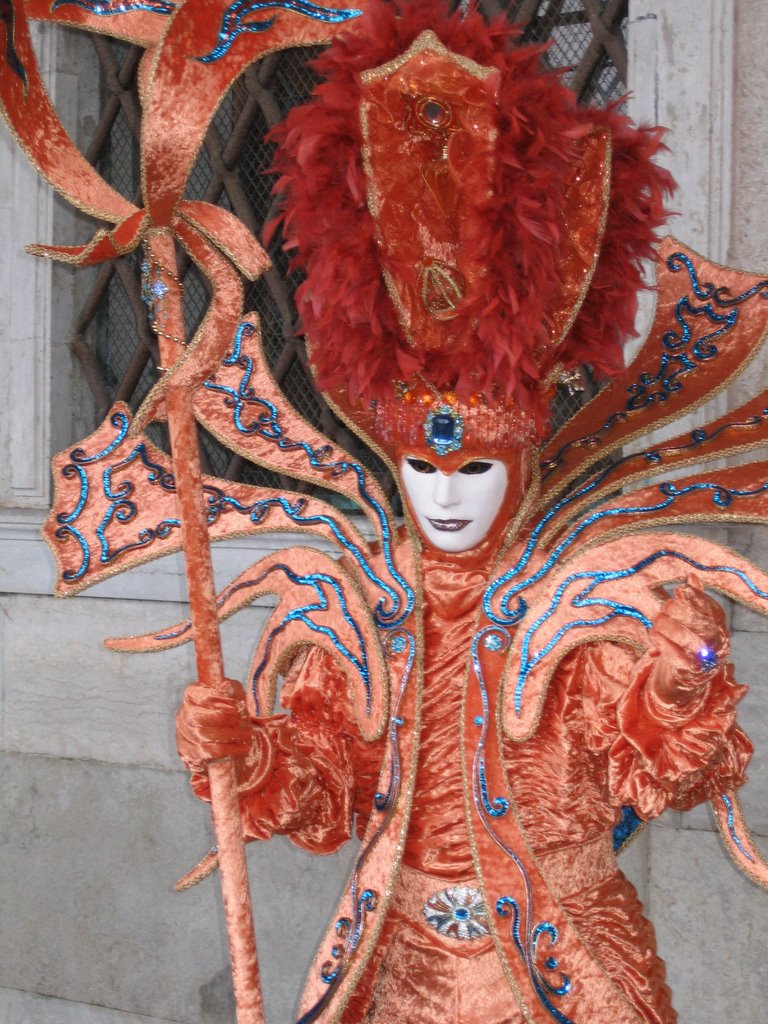
Venice is all decked out in splendor for Carnevale. People from all over the world elaborately dressed in masked costumes stroll slowly under the porticoes posing to be observed for picture taking. Many of the designs are traditional baroque clothing excessively decorated with rococo in gold and bright colors, but others are elaborate statements of fancy in even more brilliant colors. Friday was the fashion show and the judging of the best costume for 2006. One of the judges was a famous Italian actress so the paparazzi were all over the place trying to catch the perfect photo of Miss Beautiful in her 18th century gown. The atmosphere was a frivolous elaborate pretense but the quality of the costumes and attention to detail was unbelievable and most of those who were unmasked seemed to be middle age and having a fabulous time.
At choir practice the celebration of sausage continues. Jo^sko cut his first homemade salami to share with us all. The carving was preceded with a speech sharing that he does not make sausages and salami just for himself, but for his family of relatives and friends and he wants to share the first flavor of the year with those of us in his choir. We toast Jo^sko with Na zdravje!, and everyone [except me] study the color, the texture and savor the taste of the new sausage. Dober, dober [good] is echoed around the table and more salami is gobbled up with bread, cheese and pickles. The wine this week is a different wine. Jo^sko was really surprised that I was able to discern the difference in the flavor, but this white wine has a greater depth of flavor, a richness that is different than that which he usually serves. He calls it a zelena [green] wine made from a grape unique to the region. Most of the wines are from French grapes, but this is a grape that is not often grown and the flavor is mixed and blended with a large dose of Slovenian pride. He offered me 100 congratulations because of my abilities to discern, and brought out the grand ringing crystal glasses for me to swirl, sniff and then taste. The glass did not make it taste better; I think I would have liked it even in a paper cup. Jo^sko’s wine is not aged in barrels, but made in and served from large stainless steel vats. I think the alcohol content must be low because the texture is light and easily consumed with very little residual affect. But I am discovering and there is so, so much to learn about wine.
I am experiencing a language break through!!! For 3 hours on a rainy cold Monday I studied Slovenian grammar trying to make sense of cases and declensions. Every noun or adjective takes a different ending depending on how it is used. So one must consider the four declensions 1. a feminine noun ending in “a,” 2. a feminine noun ending in a consonant, 3. a masculine inanimate or animate noun 4. a neuter noun ending in “o” or “e”. And there are no articles as in French or Italian to tell you the gender. Then depending on the use of the word the endings change in the different cases. The nominative case is easy – the subject of the sentence – no changes. The genitive case is the direct object of all negative verbs, 1. “a” becomes “e”, 2. consonants add “i”, 3. “u” is added to masculine noun [Robertu], 4. “o” and “e” become “a”. Each case has its own set of rules [plus the million exceptions]. The dative case is use for the direct object when something is done for someone or something. The accusative case is used when seeing someone or something. The locative case is used for location. The instrumental case is used with someone or something, and each has 4 declensions. And I haven’t even mentioned plural or dual [if there are 2 involved]. So for a simple word like table [miza] you have 1. miza, 2. ni mize, 3. mizi, 4. mizo, 5. mizi, 6. mizo, and plural 1. mize, 2. ni miz, 3. mizam, 4. mize, 5. mizah, 6. mizami. The breakthrough comes with understanding this. I can’t do it, but I understand it. Finally when I hear a word I can discern the root word and recognize that there is an ending and not become debilitated because of the different sounds [oh by the way sometimes the words are then pronounced differently or stressed differently because of the ending too]. Slow I plod along one word at a time, one phrase at a time and eventually I may be able to create an accurate sentence.
It is time to celebrate the end of winter and the beginning of the Lenten season. Buds on trees and bushes are beginning to pulse and swell and everywhere there are preparations for Carnival. In Slovenia the celebration is called Pust based on pre-Christian traditions of driving the winter away to allow room for the spring to come rolling in. There are a variety of celebrations around the country each with its own traditions and costumes. The celebrations culminate on Shrove Tuesday where many of the floats and costumes are burned along with the negative bad feelings from the past year. Then after Ash Wednesday people fast [post] giving up the fatty foods and meats that kept them warm in the winter and prepare their hearts, souls and gardens for new life.
The Kurenti, which at one time were believed to have the power to chase away winter and usher in spring, are the central figures of the annual Kurentovanje festival.
The Slovenian rite of spring and fertility is called Kurentovanje. This event is celebrated for 10 days. Although the origins of Kurentovanje festivities are obscure, the celebration may have come from earlier Slavic, Celtic or Illyrian customs. Similar traditions are found throughout Central Europe in parts of Croatia, Hungary, Serbia, Bulgaria and elsewhere.
Kurentovanje is a distinctive pre-Lenten festival. The name comes from the festival's central figure, the Kurent, who in earlier times was believed to have the power to chase away winter and usher in spring. During this extravagant festival, Kurent, the god of unrestrained pleasure and hedonism, comes to life. Groups of Kurents (kurenti) dress in sheepskins with cowbells hanging from their belts. They wear furry caps decorated with horns, streamers, feathers and sticks.
The Kurent mask is a major work of folk art in Slovenia. The masks are made of leather, with two holes cut out for the eyes, and a single hole cut out for the mouth. The holes are surrounded with red paint. A trunk-like nose is attached, along with whiskers made of twigs and teeth made of white beans. The final touch is a long, red tongue which dangles down to the chest.
The Kurents travel throughout the town, moving from house to house to scare off evil spirits with bells and wooden clubs that are topped with hedgehog spines. A devil acts as the leader of the procession. He is covered in a net to catch souls. The Kurents are presented with the handkerchiefs of young girls. These gifts are attached to their belts. The people of the town smash clay pots at the feet of the Kurents for good luck and good health.
This info came from www.snpj.org. We attempeted to go to Ptuj where they have the largest Kurent festival, but the bus connections made it impossible to get there. We will try another year when we have a car. In other festivals the creatures paint their bodies green using leaves and growing things as decorations with bells to scare away the winter. These festivals are accompanied by costume parades, little children begging for candy from house to house, playing tricks on people and lots of parties with good food freshly made sausage and salami, and flansiti [a delicately thin fried pastry similar to elephant ears at the fair]. I went to the Karnival parade in ^Sempeter and there young men were dressed in the kurent costumes along with floats that made political statements about bird flu, the introduction of the Euro next year and the mayor who was being accused of being a gypsy.
Venice is all decked out in splendor for Carnevale. People from all over the world elaborately dressed in masked costumes stroll slowly under the porticoes posing to be observed for picture taking. Many of the designs are traditional baroque clothing excessively decorated with rococo in gold and bright colors, but others are elaborate statements of fancy in even more brilliant colors. Friday was the fashion show and the judging of the best costume for 2006. One of the judges was a famous Italian actress so the paparazzi were all over the place trying to catch the perfect photo of Miss Beautiful in her 18th century gown. The atmosphere was a frivolous elaborate pretense but the quality of the costumes and attention to detail was unbelievable and most of those who were unmasked seemed to be middle age and having a fabulous time.
At choir practice the celebration of sausage continues. Jo^sko cut his first homemade salami to share with us all. The carving was preceded with a speech sharing that he does not make sausages and salami just for himself, but for his family of relatives and friends and he wants to share the first flavor of the year with those of us in his choir. We toast Jo^sko with Na zdravje!, and everyone [except me] study the color, the texture and savor the taste of the new sausage. Dober, dober [good] is echoed around the table and more salami is gobbled up with bread, cheese and pickles. The wine this week is a different wine. Jo^sko was really surprised that I was able to discern the difference in the flavor, but this white wine has a greater depth of flavor, a richness that is different than that which he usually serves. He calls it a zelena [green] wine made from a grape unique to the region. Most of the wines are from French grapes, but this is a grape that is not often grown and the flavor is mixed and blended with a large dose of Slovenian pride. He offered me 100 congratulations because of my abilities to discern, and brought out the grand ringing crystal glasses for me to swirl, sniff and then taste. The glass did not make it taste better; I think I would have liked it even in a paper cup. Jo^sko’s wine is not aged in barrels, but made in and served from large stainless steel vats. I think the alcohol content must be low because the texture is light and easily consumed with very little residual affect. But I am discovering and there is so, so much to learn about wine.
I am experiencing a language break through!!! For 3 hours on a rainy cold Monday I studied Slovenian grammar trying to make sense of cases and declensions. Every noun or adjective takes a different ending depending on how it is used. So one must consider the four declensions 1. a feminine noun ending in “a,” 2. a feminine noun ending in a consonant, 3. a masculine inanimate or animate noun 4. a neuter noun ending in “o” or “e”. And there are no articles as in French or Italian to tell you the gender. Then depending on the use of the word the endings change in the different cases. The nominative case is easy – the subject of the sentence – no changes. The genitive case is the direct object of all negative verbs, 1. “a” becomes “e”, 2. consonants add “i”, 3. “u” is added to masculine noun [Robertu], 4. “o” and “e” become “a”. Each case has its own set of rules [plus the million exceptions]. The dative case is use for the direct object when something is done for someone or something. The accusative case is used when seeing someone or something. The locative case is used for location. The instrumental case is used with someone or something, and each has 4 declensions. And I haven’t even mentioned plural or dual [if there are 2 involved]. So for a simple word like table [miza] you have 1. miza, 2. ni mize, 3. mizi, 4. mizo, 5. mizi, 6. mizo, and plural 1. mize, 2. ni miz, 3. mizam, 4. mize, 5. mizah, 6. mizami. The breakthrough comes with understanding this. I can’t do it, but I understand it. Finally when I hear a word I can discern the root word and recognize that there is an ending and not become debilitated because of the different sounds [oh by the way sometimes the words are then pronounced differently or stressed differently because of the ending too]. Slow I plod along one word at a time, one phrase at a time and eventually I may be able to create an accurate sentence.



Subscribe to:
Posts (Atom)
