Saturday, December 22, 2007


Crossing from Italy to Slovenia


Slovene border


Fireworks


Costumed Italians

One of my friends said, “I can’t believe that the border is down. There have been border crossings for my entire life. It just seems impossible!”

The borders between Slovenia and Italy and Austria were officially opened on 21 December when Slovenia became apart of the Schengen border-free area. At one minute past midnight lights were lit by Slovene and Italian officials together on both sides of the border, bands played, costumed citizens danced and fireworks lit the night sky. We stood on the bike path on the old railroad track that had served as the border between the two countries since 1947 and watched the celebrations on both sides. After the official opening and dismantling of the crossing gates, masses of people walked freely between the two countries, for the first time, without document checks.

This border was more than simply the line dividing two nations, but it also was the division between people of the same culture. Gorizia, Italy was once a city of Slovene majority. After WWI the city of Gorizia and the region of Primorska were annexed to Italy and the Italians began to bring citizens from other parts of the country to Gorizia for work and to increase the Italian population. After WWII Primorska was returned to the Slovenes [at the time Yugoslavia], but Gorizia remained Italian. Nova Gorica [new Gorizia] was birthed from a field of roses so that the Slovenes could live in Slovenia and not have to live any longer under the ruling of the Italians. Some people could not leave their families, their businesses, their farms, their houses and had to stay in Italy. The border separated them from family and friends and even some farmers had vineyards in Goriška Brda, Slovenia and Colli Orientali del Friuli, Italy straddling both countries.
One friend tells of hearing the bells tolling for the death of his grandmother in Italy, but none of his family was allowed to cross the border to attend the funeral. Another tells of smuggling meat across the border with her mother, as a young girl, in hopes of earning some money by selling it to Slovenes in Italy. And a popular story is a day when the border was opened without stipulation and people went in mass to visit family and friends in Italy, each returning with a broom slung over his/her shoulder; a commodity more precious than gold.

Prior to 21st December everyone had to show documents when passing to the other country and there were certain borders for locals and borders for all others. Because we do not have EU passports we could only pass at the international crossings even if we were walking or riding our bikes. Now because of the free borders we can cross into Italy just 2 blocks from our apartment.
This celebration was the biggest Schengen opening and creates a 24-country area where EU citizens can travel without passports. In addition to Slovenia , Estonia, Hungary, Latvia, Lithuania, Malta, Poland, Slovakia and the Czech Republic also joined the Schengen.

To stand and watch the excitement and feel the energy of breaking down barriers was a thrill. Although our friends here have experienced other moments in history it is seldom that I have been able to feel the breath of change hot on the back of my neck.

Friday, November 30, 2007


Croatian Coast
Trogir from the church tower
Holidays are one of the many nice things about working in the schools in Slovenija. There is a week holiday for each season, and this gives us the opportunity to travel and discover more distant places. This fall holiday, at the end of October and beginning of November, we decided to drive down the coast of Croatia as far as Dubrovnik enjoying the coastal road along the sea and stopping at the ancient villages along the way. The Dalmatian coast is dotted with islands, some inhabited, some naked of trees and life, so the view along the coastal road is interesting and varied.

There were Indo-European settlements along the Adriatic as long ago as 1200 BC and the people were known as Illyrians. The Celts followed much later in the 4th century BC but were defeated along with the Illyrians by the Romans in the 2nd century BC in an attempt to protect their ships from attacks from the Dalmatian coast. The Romans built great roads, thriving walled port cities with community buildings, amphitheatres, grand palaces and aqueducts to transport water. The Roman Empire in this area was destroyed by relentless attacks by the Huns, Vandals, Visigoths and Longobards. In the 6th century the Avars conquered the land and the Slavs, Byzantines, Croats [a Slavic people possibly from Iran], Franks and Hungarians followed. Croatia was not united until 1058, but the land was still fair game for the Hungarians [again], Tartars, Turks [many times], Venetians, and in the 1500’s the Hapsburgs from Austria, then Napoleon, then Austrians again until the dissolution of the Austrian-Hungarian Empire as the result if WWI. In 1918 the Croats joined the Slovenes and Serbs in forming the State of Slovenes Croats and Serbs, but many of the cities along the coast were annexed to Italy and the country remained divided. During WWII the country was invaded by Nazi Germany and Fascist Italy and resistance to these forces resulted in the creation of the Partisan movement and eventually the Communist Party under the leadership of Tito [of Croatian, Slovene mix] and the formation of the country of Yugoslavia. In1991 Croatia declared independence from Yugoslavia [a day before the Slovenes] and a devastating war between neighbors broke out between the Serbian factions and the Croatian nationalists. 1995 peace was declared, but UN forces monitored the land until 1998. Now Croatia is in negotiations for acceptance into the European Union, but there are nationalist who are afraid that joining will not be the best for Croatia, so the conversation continues. But with this history it is no wonder that Croatian people want to be autonomous without the dictates from elsewhere.
When we travel all day in our 1995 Twingo along a road originally built by the Romans, past medieval villages, we are flabbergasted by the amount of traveling done by foot, on horse back, and bumping along in wagons. Modern humans think that we are so mobile with the easy access to airplanes, trains and cars, but in ancient times they traveled unbelievable distances in conditions we would think were less than desirable. Men must have been away from home for years fighting in far distant exotic places while women were home tending the homestead and family. My romantic image of the homey peasant farm, multiple generations snuggled around a blazing hearth after a day of hard work is distorted by the realizations that they had great fear of invasions, the loss of the man of the house for years and what strength the old people and women needed to survive.

Bob visited Dalmatia in 1972 with his parents. His memory is desolate hillsides divided into plots by stone fences and small isolated villages clustered in bays where a port for trade and fishing was possible. 35 years of progressive modernism has drastically altered the landscape. Now the hills that rise directly from the depth of the sea are scared by tourist apartments and hotels. The Croatian tourist board advertises Croatia as “The Adriatic the way it used to be”, but there is little of the pristine beauty Bob remembered to be found along the road. The 2 lane road hugs the hills side and I can’t even imagine how awful it would be to travel the twist and turns in the height of tourist season. All these apartments must be filled with people from somewhere and the only way to get there is by car. The road must be impossibly impassable. The high hills still are divided by stone walls, but no longer do sheep graze or vegetables grow. Certainly the standard of living is much higher and people earn their living during the summer giving them the winter months to recoup and rebuild. No longer do they need to fish the sea daily or trudge the high slopes to raise food to survive, but I wonder what else within their lives and culture is lost. I know that I am the worst kind of tourist. I want to visit the “old country” and see people living the simple life; instead what we see is entrepreneurship at its best. People add multiple stories with private rooms to their homes; they advertise with a soba/camera/zimmer/ room sign and rent them out to people passing by. We made no reservations, but waited until after dark and found a sign lit up and knocked on the door. In each case we were warmly welcomed, given a clean room with a private bath and comfort for the night.

The main cities we visited were Šibenik, Trogir, Salona Dubrovnik and Cavtat. All have been beautifully restored. The pedestrian areas and buildings are made from quarried Dalmatian stone, arches cover the sidewalks connecting the buildings, stairs polished from generations of feet lead to gardens and city walls. Small shops serving residents and tourists peak out from under layers of ancient stone, some clearly stolen from Roman structures. Benches are placed under palm trees and churches appear around every corner. The colbalt sea is ever present by sight, smell or the taste of salt in the air.

I really liked Salona, a Roman community near Split, named after the salt that was harvested there. The foundations of an ampitheatre, temples, baths, homes, walls, gates and roads remain. One man, Frane Bulić, spent much of his life as and archeologist uncovering this city that once was the richest and most populatedRoman city in the mid-Adriatic area. It is easy to see the shapesof the city and in the late afternoon and feel the ghosts of residents who wore grooves in the stone road under the main gate into town. The sophistication of the Roman infrastructure is fascinating. An aquaduct brought water up from the river to the city and covered trenches to displace gray water are still visible . I thrill in walking the path of the ancients. Most of the paving stones have been used for other purposes in other places, so grass carpets the roads and sidewalks giving the place the sense of peacefulness. Yet along the river are oil storage tanks and the modern buildings of Split loom in the distance, but for a moment I can imagine what it must have been like when it was a thriving community.

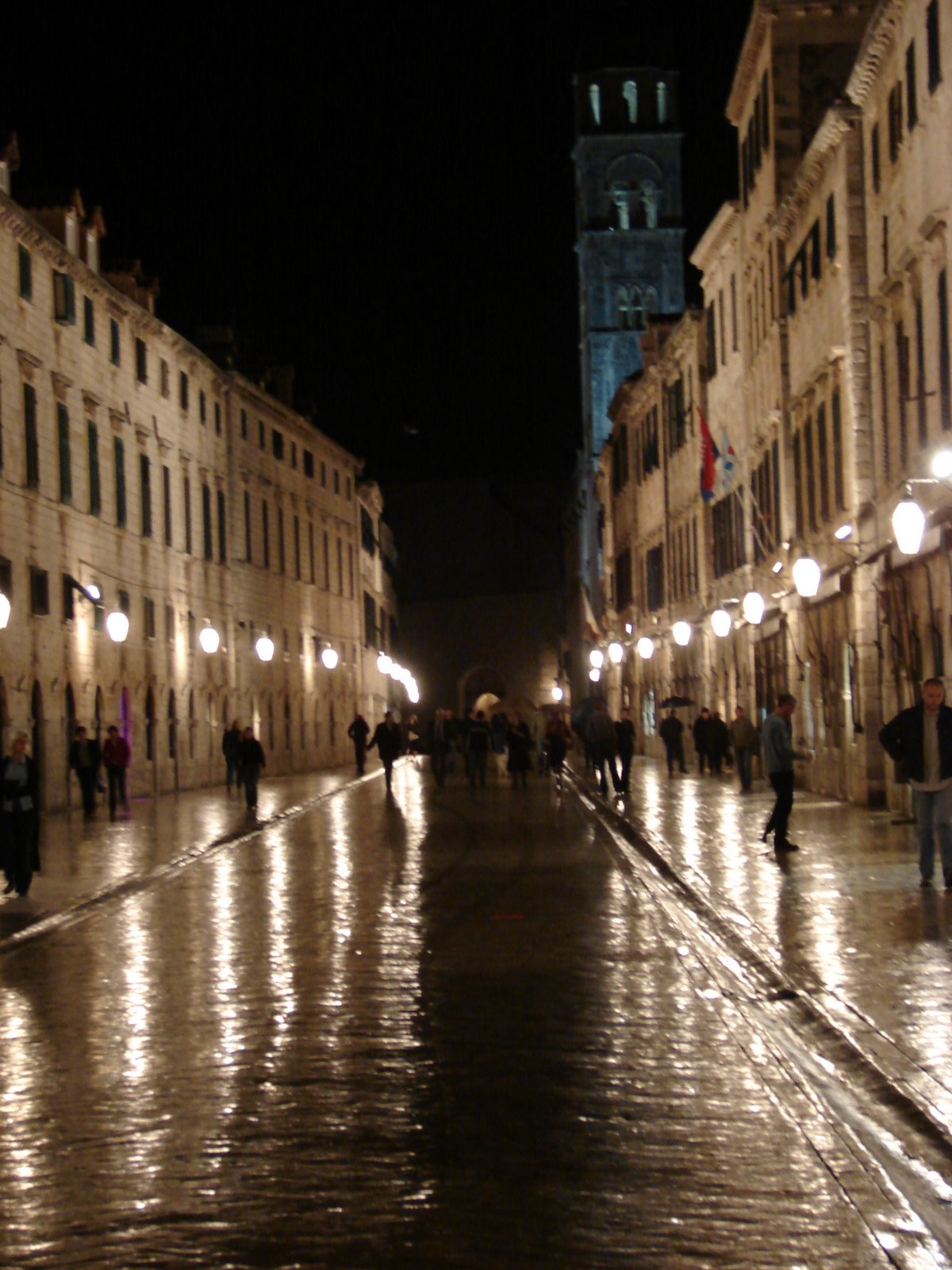
Dubrovnik was our main destination. To get there we needed to travel inland past the Neretva river delta. This swampy area has ancient raised walled beds for growing that can only be reached by boat. The sweetest tangerines I have ever tasted hang heavy on the trees and stands sell them along the road by the kilo. We ate them like candy with juice dripping everywhere. The approach to Dubrovnik is a dramatic breathtaking view from the hillside. Goats peered down at us when we stopped to look at the city jutting out into the sea. The shape of the walled city makes it clear why this was a safe fortress for centuries. It became the independent Republic of Ragusa in 1382 and the wealth of the inhabitants and the power of the sailing fleet made it a force to rival Venice. A devistating earthquake destroyed the center and the buildings we visited are those rebuilt in 1667. The exterior walls were massive protection from Turkish invasions, but they did not protect the city from the bombing of the Yugoslav army from autumn 1991 to May 1992. From the hillside over 2,000 bombs and guided missiles rained down on the city disturbing half of the houses and all the monuments. UNESCO, the European Union and private sources funded the rapid reconstruction of the city beginning in 1995. As we walked along the streets looking up at the rich design of the buildings it is difficult to imagine the poison that would cause people to destroy such an ancient treasure, but then the expertise, the hard work, the creativity that restored the city shows the goodness in humans that I hope will balance the hatred. We were very happy to be in the city off season to wander around in a slow stroll absorbing the ambiance of the empty streets. We stayed in a B&B just outside the walls and when the second day was pouring rain we had a lovely place to snuggle up and watch the storm come in waves from the sea.

We took an over night ferry from Dubrovnik to Rijeka on the way home. The weather was gray and the wet windy road would have been a tough drive. It was much nicer to sit in the lounge next to the window and watch the coast line pass us by. We met an American couple from Texas and it was really nice to just sit and talk over drinks and dinner. People here speak beautiful English, but it is very relaxing to speak English with people that share a common culture. We can use phrases, make references that are understood by all and it was a delight.
When I visited Bari, Italy with the teachers the first year we were walking through the middle of the old city and there in front of us were Roman ruins. I was slowly dragging at the back of the group looking at every little detail while the rest of my friends rushed by. I stopped at the Roman columns and said “Wait are these Roman?” One teacher stopped and said, “Yes I think so”. “But you just rush by!” I said incredulously. “It’s just more old things”, she said “we see old things all the time.” I will never tire of visiting the ancient sites of this area, but it is amazing how one medieval village begins to look like another after a while. I can’t even believe I am saying that!!


Neretva river basin
Solona Roman ruins
Split seen from Solona


Dubrovnik


Ferry ride

Tuesday, November 13, 2007

Go to youtube to see a beautiful ad for Slovenija.

http://www.youtube.com/watch?v=FPYx0JniVGM&eurl=http://erikobid.blogspot.com/2007/10/slovenia-home-sweet-home.html

Saturday, November 03, 2007


Autumn in Slovenija

Autumn is beautiful this year in Primorska. The leaves seem to have more color than in the past couple of years and the florescent gold against the sea blue sky draws us deeper and deeper into the mountains. Higher in the hills there are fewer maroon/brown oak trees and more beech forests; yellow laced in brown. The iceberg white boulders rise up from the moss covered forest floor lit by this tent of yellow. Mushrooms of all colors, healthy and poisonous, abound along the path while the prickly shells of the chestnuts and the crunchy beech nuts prevent us from walking silently along the path. The elves know we are there, and it is the perfect hiding place for them to peak at us as we hike past.

As always we are shocked by the rugged terrain and the insanity of fighting war amongst these natural obstacles. Both world wars damaged the heart and soul of this land. The Partisans practiced their guerilla warfare against the Nazis and the Italian fascists only 30 years after WWI devastated everything in its path. They retaliated from deep in the mountains of Primorska and reclaimed much of the territory populated by Slovenes that had been captured by the Italians. The stories are horrific on both sides.

The Italians were cruel masters in this conquered land after WW I. People were only allowed to speak Italian, Slovene was not taught in the schools, some sir names were changed to Italian, people were sent far from their families to work or as a punishment and the towns were called by the new Italian name rather than the name of history. Impoverished southern Italians were brought to Gorizia to populate the area laying claim to the land for Italy.

Partisan popularity was great in this area and support for the Slavic home guard who would free them from their oppression. During WWII the Nazis also claimed the territory and their retaliation for the killing of German soldiers included butchering the men, burning the towns and sending the women and children away. The village of Lokve [45 minutes from our home] was burned twice by the Germans leaving the people in the depth of winter without shelter or food.

It must have been heartbreakingly difficult for the Slovenes to choose their loyalties. The Fascists were foreigners who had taken their country by force ruling with great cruelty. The Nazis were forcing themselves on all the countries around with reports of greater atrocities. The Partisans were locals fighting underground to reclaim the land for the original inhabitants, but they were aligned with the communists and people had fears for the future of their country and their religion. The church did not condone the opposition to the Germans and the Italians, yet these were the enemy by all definitions. Because the communists were aligned with the allies there were few resources for fighting communism, so the domobranci resisted the Partisans and were armed and fed by the Germans. All the political choices had negative consequences and depending on the outcome of the war and the mind set of the victor, ones choice could provide either freedom or death.

Unfortunately after the war was over the killings did not stop. In 1945 tens of thousands who had resisted the Partisans and aligned themselves with the Germans fled the country. Many went to Argentina, Australia and the United States, but others attempted to flee to Austria. At the border after traversing the Julian Alps on foot, in horse drawn carts or piled into trucks the British army turned them back. They were told that the Allies were going to take them to safety to Italy, but instead they returned them to the victorious Partisans under the leadership of Tito. These Slovenes [men, women and children], along with Croatian Ustaše, Serbian Četniks, Croatian civilians and soldiers from the Italian and German armies were seen as traitors to the homeland and hundreds of thousands were brutally beaten, murdered and dumped into mass graves. Some of them were war criminals, but others were civilians who were assassinated without a trial. The locations of the graves and the stories that accompany them have been hidden for generations and are just now being discovered. In 1999 while building a road along the Austrian border near Maribor a mass grave was discovered in the Tezno forest. The remains of over 1,000 people were found in an anti-tank ditch that had been hidden for 60 years.
Near the village of Lokve there is a sink hole that was the sight of mass graves of Slovenes and Italians following the war. The area is identified as a cemetery, although there are no graves marked, and a massive chime with a deeply resonating tone is the monument to those who were massacred.

Primorska is celebrating the 60th anniversary of the Partisan movement this fall with events, speeches, parades, singing and remembering. The town of Nova Gorica, built as a new town in the new country of Jugoslavija by the new leaders from the Partisan movement, had a giant celebration. The organization TIGR [Trieste, Istria, Gorizia and Rijeka], wishing to reclaim all these Slovene areas to their rightful inhabitants, remains a presence. The old men stood at attention with their flags, their caps, their memories. After the festivities with good jota in their bellies and a glass of wine in their hand they gathered in groups all over town to reminisce through stories and songs.

I watch all the events. I see their faces, the glow of pride, the memories of what it was like to be involved in changing the face of Europe forever and I wonder how many stories have gone untold and are best to remain hidden.


Partisan 60th anniversary celebration

Lokve [village burned by the Germans]

Area of sink hole mass grave near Lokve


Faces of the Partisans

Wednesday, August 22, 2007


WWI military road

Isonso Front

Kanal on the Soča River, destroyed in WWI


WWI bunker

WWI litter - cans and tins

Modrejce military cemetary 2,750 soldiers buried in 550 graves


I am magnetically drawn to WWI battlegrounds. They pull me despite the resistance of my pacifist heart. I have no idea why the hillsides, where blood watered the soil, have an inexplicable fascination to me. I am attracted to the art, architecture, clothing and music of the time around the turn of the 20th century, but why places of war?

WWI lives here in the conscious of the people. The war was horrendous, and all around this area there are daily reminders of the horror. Soldier cemeteries, the grass cut and graves aged but not abused in any way, showing the 90-year-old respect for the dead even if he was an enemy.

There are many places where litter of war can still be found on the hillsides. Along our hikes are foundations of stone buildings smothered with moss, walking paths that were once military roads, and sometimes rusted metal plates, tin cans, or other mysterious metal objects are found lying where dropped 9 decades ago. There is surprising peace. The energy is not one of absolute despair, but of acceptance that the sacrifice was not in vane. The ground is carpeted with creeping myrtle, ivy or long arched feathery grass as if someone planted ground cover to hide the memory. 90-year-old trees tower above, shading the forest floor preventing choking undergrowth and scrub bushes. Fresh blood pink cyclamen dribble at the edge of the paths beside pure white rocks that jut from the ground as uncut memorials for those who have fallen. And it is silent. Only a few bird motifs, but no rustlings of ground squirrels or mice break the white noise of the Soča River below. A place where I can sit in absolute complete stillness.

WWI began at the end of the colonization of the world. Places were spoken for and the Austro-Hungarian Empire, Italy and Germany found themselves without colonies to compare to Great Britian, France and Russia. Europe was divided in two; Austria and Germany with great interest in the Balkans and Russia, England and France giving support to the Balkans to keep the Germanic influence at bay. When Archduke Francis Ferdinand, the Austrian hier to the throne, was shot by a Bosnian revolutionary youth in Sarajevo 28 June, 1914 the tensions could no longer be kept under control and the world exploded. War broke out in the late summer of1914 with the Austian ultimatum to Serbia, the German declaration of war on Russia and France, and the British declaration of war on Germany. Italy promised neutrality in 1914, but when Britan and France promised Italy, if victorious, the territories of Tyrol, the city of Trieste [Trst] the provinces of Gorizia [Gorica] and Gradisca [Gradiška], the basin of Tarvisio [Trbiž], part of the Duchy of Carniola extending the watershed, the Istrian peninsula, some o f the Croatian islands and a share of territories in Asia Minor and Africa, they saw hope for expansion and declared war on the Austro-Hungarian Empire 23 May 1915. The United States joined the war in 1917 and after the death of 10 million youth it was finally ended 11 November, 1918. Insanity had become governmental policy.

The mountainous border between the Austro-Hungarian Empire and Italy is the land of the Slovenes where war dominated their world for 29 months. All equipment had to be hauled by men, mules or dogs up switch back roads newly cut into the face of the mountains. Kitchens, milking parlors, butcheries, hospitals, tanneries, laundries, gardens, barracks, and stables were built of local stone. All that the soldiers needed had to be brought by foot, or made in army villages of huts clinging to mountains sides. All supplies brought up the mountain were made from metal; canteens, digging tools, lanterns, repair tools, cooking supplies, guns, coffee mills, cannons, cheese graters, steel beams, generators, explosives, lights. Water collected from rain and snow was stored in wooden barrels and left to fester in hot weather. Men were dressed in heavy wool uniforms, their legs wrapped in layers against rain, snow and ice, cleats were attached to the bottom of their boots with leather straps for traction on ice and snow. Wool capes covered their shoulders and nothing dried once it was wet.

1916 was the worse winter of the century and millions of men were stranded high in the mountains in snow over a meter deep. Tunnels were dug as protective trenches in the snow, like igloos. The soldiers hid themselves in arched snow caves with windows for shooting the enemy and dodging icicles caused by the heat of their bodies. ''It was so cold that fifty men from the entire battalion had to descend from the mountain due to frozen feet... I stayed in a trench for 24 hours, crouching among dead bodies, ours and those of the enemy. The stink was unbearable, and to tip it all, we had to resist a fierce attack by the enemy, which we repelled. A lot of our comrades died because they were hit in the head when they rose over the bulwark to shoot... The rations were scarce, consisting mainly of bread, cold boiled meat of lean taste! Water is brought in skins; it is very scarce and stinking ''( from diary of Virgilio Bonamore 2 August 1915 on Mt. Batognica from display in the Kobarid WWI Museum.) ''The trenches were an unfathomable maze of headquarters, food deposities and arsenals, first-aid posts, kitchens, artillery bases and emplacements for other weapons, deep shelters, loop holes, enlarged sites from which grenades were launched, observation posts etc.; in them there centred the life and the warfare, the sleep and the rest, the death the sorrows and sufferings as well as the modest joys of the soldiers existance.'' (Svoljšak, Petra; The Front on Soča; Ljubljana: Cankarjeva založba, 2002) “My heart breaks at the sight of these men in the prime of their youth who were mangled by shells, and many will perish for the sacred and rightful cause about which most of them have not the slightest idea.” (Gregorio Soldani 2 November, 1915.)

I spent over 2 weeks this summer in the Kobarid area where 11 offensives in the Soča [Isonso] River Valley were fought. Now the roads and paths tread by the soldiers are the trails of vacationing hikers. Trenches, bunkers, observation points and buildings are attractions of the historically curious. Kobarid has a wonderful small museum, not colored with national politics, that tells the story of the lives of the young men. The museum walls are cluttered with photos of everyday life on the mountain slopes and other events worth documenting. Post cards that had been printed and sent showing the devistation of towns tell the tales of the locals trying to survive in the midst of chaos. Ancient church records were destroyed with the churches and the towns that housed them, so the birth and death history of families was lost forever and when the war was finished the people had to rebuild their lives from the rubble of a world gone mad. The town of Šempeter, where we live, was flattened and all the buildings where we shop and drink coffee were rebuilt from the remains. Sveta Gora where I sing every Sunday was devistated because of it's strategic location on top of the mountain, but was rebuilt by the Italians in the original style. The presence of the power to survive, the will to carry on is evident in the buildings we see every day.


WWI trenches and stairs to and from trench

Charnel House 7,014 Italian soldiers buried here

WWI military road now hiking trail

Friday, August 03, 2007


Jelly fish

Šežana coast

Coast near Umag

Piran


In the Sea
Veli Ločinj
Senj
By the sea, by the sea, by the beautiful sea,
You and I, you and I, oh how happy we’ll be…

This summer I am spending some extended time on the Croatian coast along the Adriatic Sea. Within an hour we can drive by car to Croatia. If we time it just right and take the back roads we avoid the crush of traffic escaping the heat and the long lines at the border. The Croatians seem to resist welcoming the most common visitors from Italy, Slovenia, Austria, Germany and even as far as the Netherlands by making the summer tourist queue into one line to pass through the border. It almost seems as though they are saying, “What are you doing? Why don’t you just stay at home?” It is a forced cultural lesson. No one at the crossing gates is in a hurry. They seem to insist that we all start behaving like good Mediterranean residents and live life at a calmer pace. The roads are single lanes leading to and from the border, and the only travelers who are able to go quickly to the coast are the motorcycles that squeeze down the solid line between cars where there is dangerously not enough room. The car travelers must form a slow train to their holiday spot and there is no point in becoming anxious.

All along the Croatian coast, villages that were once supported by fishing or grazing animals are now swarming with tourists from all over the world. Hotels, resorts and summer homes of bright colors rest along side stone walls that once kept sheep from wandering. Medieval villages birth kitschy tourist shops selling things made from shells from every stone doorway. Captains of fishing boats are now tour guides to the islands and beaches. Single-family homes are being built to include rooms to rent or apartments in neighborhoods where each house posts a sign “Soba, Camera, Zimmer, Rooms” The tourist season is six months and the rest of the year is preparation for the tourists.

The economy appears to be thriving, but the attitude projected by the wait-staff in cafés and restaurants demonstrates the love hate relationship found in so many tourist areas. When I worked in Estes Park, Colorado we hated to see the tourists come. They were demanding, disrespectful, rude and often unpleasant. They were there to have a good time without concern for those who provide services. The students in Amish country in Holmes County, OH used to call the gawking aging bus tours “terrorists”. Yet like these places in the US, undoubtedly the life on the Croatian coast would be too quieter with out the tourists, and no one would have enough work to be able to live there. The tourists come for peace, relaxation, old charm, water and sun, but after dark the sound of disco throbs in the air, the beaches are packed with people, the old villages are decorated with flashing neon lights, the sea is being over fished and too much sun gives you skin cancer. Maybe tourism is not as good as it seems. I wonder if these villages will be deserted like Route 66, once the fickle tourist industry chooses a “new hot” spot; leaving deserted hotels and resorts.

In our part of Slovenia the world runs down to a halting pace in July and August. Shops and restaurants close down for the holidays, the library has shortened hours and even the health clinic in our neighborhood is closed. The streets are quiet and the pace is slow to accommodate the heat. Everyone I know goes to the sea. They take the 20-minute drive to Sistiana for an evening swim or they find a favorite spot on the Croatian coast and return year after year with friends and family spending all day in the water and roasting in the sun. The sent of fresh grilled fish, bought from the door to door fish monger, seasoned with sprigs of rosemary plucked from the yard, and smoked with fresh bay leaves cut from the hedge, peppers the air. Children play after-dark games while parents chat over a glass of wine. The world is relaxed. The Croatian coast resonates summer pleasures.

The coast was bare until after the war; no houses, no hotels, only fishing villages. Like Primorska, Italians following WWI, occupied the Istrian peninsula. Slovenes who were willing to change their names and speak only Italian were relocated here to work the land. They all seemed to have lived comfortably along side the Croatians and most signs are still written in Croatian and Italian. After WWII this coast belonged to Jugoslavia and many Slovenes bought small parcels of land for seaside cottages. Made by hand of Istrian stone, the houses were modest get away places that provided leisure, known before only to the aristocracy. Now, blurring historical class distinctions, the 20th century workers were provided holidays as their rights along with jobs, education and health care and they too spent the summer at the seaside.

Nothing grew on the cliffs over looking the sea. All building materials, and plantings had to be brought from elsewhere. Families spent every weekend creating by hand summer retreats to be enjoyed for generations. Originally there was no electricity or water supplied; cisterns were built under the houses for collecting rainwater and the glow of oil lamps lit the houses after dark. Concrete docks used mostly for sunbathing were built in the middle of the night during a full moon. Bags of cement were hauled down the cliff along with fresh water for mixing. When the tide was at its lowest the men stirred from sleep and poured cement in already constructed frames until the sea water returned to the shore. The docks are more like concrete platforms of varied heights jutting along the bottom of the cliffs, some have stairs into the water, metal cups for inserting umbrellas, others have cement seats formed for sun bathing and platforms for diving. There are no signs of private property or barriers to keep people from the houses further up the hill from enjoying the sea, it seems to be public land for all to share. The cottages are close together, but made private with 50-year-old pine trees and towering hedges. Now in the time of abundance, modest cottages are being replaced by enormous elaborate all season homes or rental apartments.

The sun is so beastly hot that I go swimming just to cool down. Never have I experienced anything so marvelous! The sea temperature is 25° [77°] and with the heat index of 41° [105°] the experience was amazingly refreshing. I have been swimming in salt water in Maine where it is too cold to stay long in the water, in Florida and Georgia where the waves are too strong to do anything but play, and in Oregon where I was certain I would get frost bite from putting my big toe in the water. But this water was luscious and so amazingly salty. It is difficult to swim because the sea seems to throw me out. I am so buoyant that instead of cutting through the water with my front crawl I bounce across the surface skimming like skipping stones. But to float is like lying in bed stretched out on top, toes pointed, legs spread, paddling with fin shaped hands lying for hours on top of the water. The density of the saline solution causes me to want to curl in a fetal position, slow down my breathing and revert to prenatal quiet. But all around are tanned little bottoms gallop along the shore in and out of the water wearing floating devices and clutching beach balls. Topless moms are sunning all possible bosom styles and grandmas wear the same bikini from the “itsy bitsy teeny-weeny” years, but to less affect.

I can stand erect in the water, arms hanging at my side, feet flat as if solid with only my head above the surface. The breaststroke seems impossible because the frog kick raises me up arching my back and throwing my feet out of the water. It is easier to walk in the water using the breaststroke with my hands but an upright walking motion with my feet. Swimming is not strenuous; it’s like walking on water. The quiet of the sea makes it possible to defy gravity.

I had fish tanks as a child, and now I think if I ever settle down in just one place again I will get a cat to snuggle on my lap, a dog to play Frisbee in the yard and an aquarium filled with fish of magnificent colors to watch swim around and around. I put on a snorkel mask and below me is a mystery. I am trying to not use trite overused phrases to describe things, but there is no other way to say that below the surface of the water is another world. A social structure is created by the diamond shaped shimmering schools of fish, crabs crawling over each other, sea cucumbers that must have inspired Jaba the Hut from Star Wars, and zillions of things camouflaged from me. Large stones litter the sea floor, blocks and pillars that I imagine are Roman are decorated with mollusks, mustard gold sponges. Only the fear that my back would get too burned in the sun pulls me from the vision of wonder in the sea.

My imagination that the pillars could be Roman is possible. The Istrian peninsula like all of this area was settled during the Roman Empire, but the sea rubble could be from the marauders who followed the Romans; the Goths, the Lombards, the Frankish kingdom [789], the dukes of Carinthia, Merano, Bavaria, the patriach of Aquileia, the Republic of Venice [1267], Napoleon, Austrian Empire, Italians, Nazis, Jugoslavs or simply rubble from the massive amounts of modern construction. I prefer to think that an ancient roman constuction crew littered a rejected stone and it has been home to sea creatures for centuries.


Piran, Slovenija from Croatia
Novigrad Sunset

Monday, May 28, 2007


The teachers at Bob’s school take an annual spring educational holiday. Last year I went with them to Southern Italy, this year Bob and I both went with 35 other teachers and family members to Istanbul.

We left Wednesday evening with 2 holiday gift days from the school and returned on Sunday. We flew from Ljubljana at midnight with the Turkish truck drivers who load their trucks on tanker ships in Koper, Slovenija and then fly 2 hours to Istanbul to await their cargo. Once in Turkey the ride from the airport to Taksim square in the middle of the night gave us an unobstructed view of the city lit for the night; the Bosphorus river, the mosques and minarets, ancient walls of Constantinople and people gathering for kebabs and roasted chicken in the darkness. At first sight it was surprising the number of people casually wandering the streets in the early morning with the unexpected atmosphere of calm and safety linked by sweet smells.

Istanbul, known as Byzantium and then as Constantinople, is now a city of over 10 million people. Because of earthquakes the older buildings of the city are not tall, but they are crowded in together and piled on top of each other. The city has one foot in Europe and one in Asia spanning across the Bosphorus river that links the Black Sea with the Sea of Marmara and has been the seat of trade for thousands of years. Artifacts date settlements in this area from 5,500 BC and the history includes anyone who was anyone in the world [Ancient Greeks, Alexander the Great, Romans, Goths, Constantine, first church council at Nicaea, Theodosis I [same one who battled in the Vipava Valley in Slovenija], Justinian, missionaries from Byzantium to Slavic nations, Normans, Venetians, Turkic nomads, crusaders, Seljuk Turks, more pillaging crusaders, Ottoman Turks, countless Sultans, Sultanate women, more Sultans, Austrians, French and British soldiers and Greek forces]. Because of the influence of Mustafa Kemal Paşa [better known as Atäturk, “Father of the Turks”] Turkish land was reclaimed by the Turks, the sultanate was abolished in 1922, the country became a secular republic, the Arabic alphabet was replaced with the Roman alphabet, western dress was encouraged and all Turks were required to claim a surname. The red flag tells the story of the moon and one star reflected in the bloodshed of wounded Turkish soldiers fighting for independence. These are people proud of Turkey; proud of being Turkish and with every greeting they warmly welcomed us to their country.

Modern Istanbul a blend of new buildings, ancient remains, towering mosques, quaint cafés, crowds of people and stores, stores, and more stores. Little hidden stores the size of my bathroom, men with carts, men with card tables in the middle of the street, stores in basements, stores on side walks, stores in every nook and cranny and that is without even discussing the bazaars. It is obvious the Istanbul has been, and continues to be the mecca of trade, and buying and selling is a high art with rich social contact.


The bazaars are unbelievable!! [attached photo] Every arch hides a shop, wares tumble into the street, the colors are vibrant sparkling with brilliance, the air tastes sweet, tangy, hot and spicy, the salesmen call to you trying to guess your language mesmerizing you with friendly infectious charm and shoppers stumble over themselves, each other, the impromptu shop set up in the middle of the sidewalk, and the men carrying goods on their back or pushing wheeled carts. The entrepreneurial spirit has been tradition and culture in the Grand Bazaar since the 1450’s and the Spice Bazaar since the 1600’s. Everything is sold here; there is such abundance that the sheer number of goods in one place is overwhelming. Bargaining is expected and even fun.

We were pulled into a rug shop [“Madame I am proud of my carpets, and I want to show you, with no obligation to buy…. of course.”] and spent the most charming couple of hours with the owner learning about rugs, drinking apple tea and Turkish coffee. We went into the lower level of the shop and there were carpets and kilims everywhere; new carpets, semi old [50 years] and antique. [photo attached]There were 3 carpet rollers who flicked open the carpets at our feet showing us ones made from silk, camel hair, wool, natural dyed, synthetic dyed, tribal designs, floral patterns and each one identified by the area in which it was hand made. Kilims are tapestries that have geometric designs and are woven with a warp and weft rather than knotted like a carpet. The colors can vary greatly within the kilim because of the natural dye and the technique of weaving. Often their original purpose was not to be used as a carpet, but as a bag for carrying things. Because they were designed for use rather than decoration the exactness of symmetry is not important and they have a primitive look that I like very much. Now they are sold as floor or wall coverings and we are the happy owners of one with colors of green olives, red currants, golden wheat, camel brown, white sand, and sunshine.